

What is tretinoin?
Tretinoin is the acid form of vitamin A (all-trans-retinoic acid). Most people know it as a topical acne treatment, but its properties go much further: it alters cell proliferation and differentiation in the epithelium, promotes tissue vascularisation, and interacts with nuclear receptors found in follicular cells (Bazzano et al., 1986).
What makes it interesting in hair loss is a retinoic acid binding protein (cRABP) present in the cells lining the hair follicle. That protein makes those cells more responsive to tretinoin than the surrounding skin cells (Bazzano et al., 1986).
On its own, tretinoin can prompt a degree of regrowth. But its clinical potential only becomes clear when it is combined with minoxidil.
⚠️ Regulatory status. In France, topical tretinoin holds a marketing authorisation for the treatment of acne: using it against androgenetic alopecia is off-label prescribing, under the sole responsibility of the prescribing doctor. It remains a prescription-only medicine and is not reimbursed by the French health insurance system for this indication.
.avif)
Le finastéride est-il efficace ?
Téléchargez le dernier guide sur l'efficacité du Finastéride sur les hommes atteints d'alopécie andro-génétique.
What is the right dose?
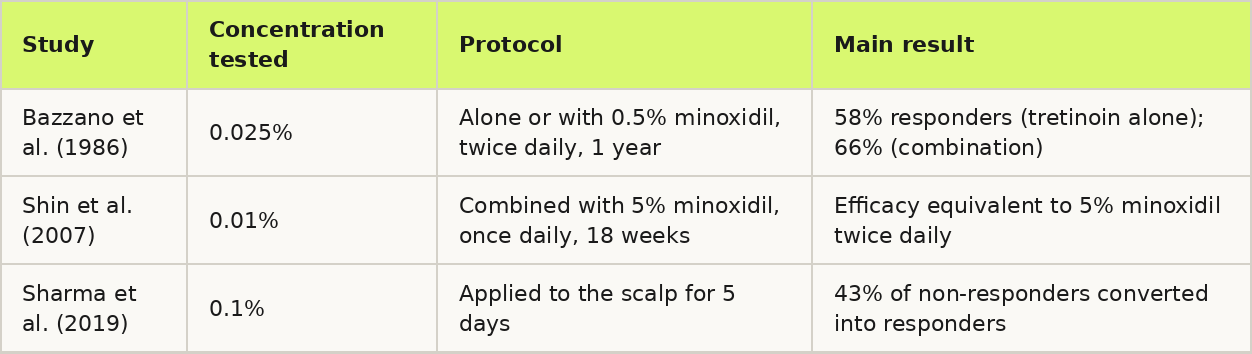
Three concentrations have been studied. The results say a good deal about the trade-off between efficacy and tolerability.
What the data suggest
A concentration of 0.01% offers the best balance of efficacy and tolerability when used daily alongside 5% minoxidil (Shin et al., 2007). It is the best documented formulation for long-term use on the scalp.
A concentration of 0.025% shows hair effects of its own, including as monotherapy, over a one-year period (Bazzano et al., 1986).
A concentration of 0.1% was used in the short protocol of Sharma et al. (2019) to test the effect on sulfotransferases, but it is not recommended for prolonged daily use on the scalp because of the risk of irritation.
⚠️ In practice. Tretinoin is photosensitising. The studies recommend applying it in the evening, on a dry scalp, and avoiding prolonged sun exposure afterwards (Shin et al., 2007; Bazzano et al., 1986).
Does combining tretinoin with minoxidil work better?
This is the central question addressed by Shin et al. (2007), a randomised double-blind clinical trial in 29 men with stage III to V androgenetic alopecia (Hamilton-Norwood).
What the study shows
The aim was to find out whether a single daily application of 5% minoxidil plus 0.01% tretinoin could replace two daily applications of 5% minoxidil alone. Adherence is what is at stake.
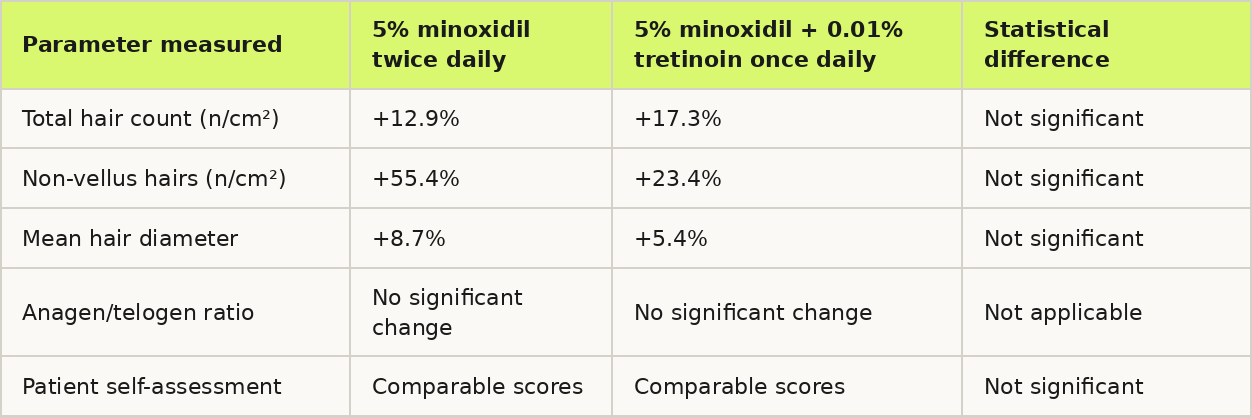
The conclusion is clear: the two treatments were statistically equivalent on every parameter measured at 18 weeks (Shin et al., 2007). The tretinoin and minoxidil combination therefore delivers the same results with half as many applications.
What about minoxidil non-responders?
This is where the finding of Sharma et al. (2019) matters most. In that study of 20 patients with androgenetic alopecia, 43% of the subjects initially identified as minoxidil non-responders (sulfotransferase activity below 0.4) were converted into responders after just 5 days of 0.1% tretinoin (p = 0.0397).
Tretinoin, then, is more than a convenient add-on. For close to half of minoxidil non-responders, it could be the key that unlocks the treatment.
What about monotherapy?
Data from Bazzano et al. (1986) on 12 patients treated with 0.025% tretinoin alone show a positive hair response in 58% of subjects, mostly moderate regrowth. These findings are preliminary and rest on a small sample, but they suggest tretinoin has an effect on the hair cycle in its own right, independently of minoxidil.
Side effects of tretinoin
Tretinoin is a well-characterised active substance that has been used in dermatology for decades. Its tolerability profile on the scalp is broadly acceptable, provided the concentration and the application protocol are respected.
What the studies report
In the Shin et al. (2007) trial, the adverse effects observed were comparable across the two groups:

All adverse effects were mild and resolved on their own within a few days (Shin et al., 2007). In the Sharma et al. (2019) study, which used the higher 0.1% concentration over 5 days, the investigators reported and observed no adverse effects at all.
In the Bazzano et al. (1986) studies, two patients were withdrawn for unusual sensitivity to the solution, pointing to possible contact dermatitis from tretinoin.
Theoretical risks worth knowing about
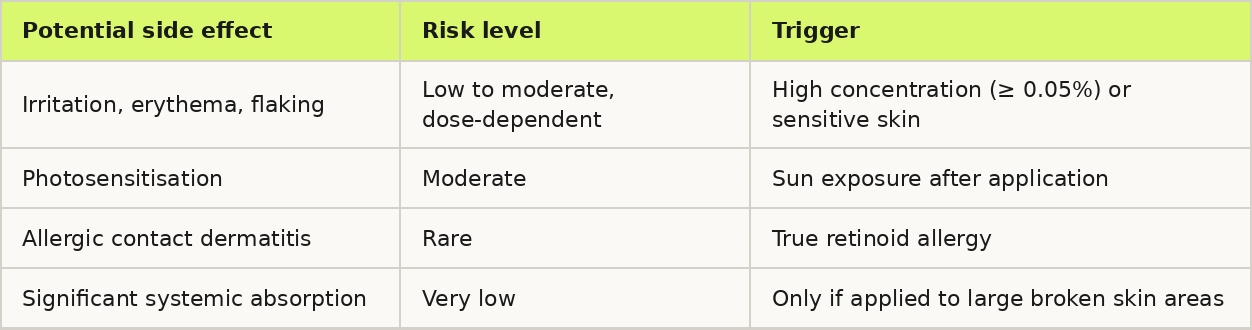
⚠️ Absolute contraindication. Tretinoin is teratogenic and strictly contraindicated in pregnancy, including topical use. Any woman of childbearing age must be told this.
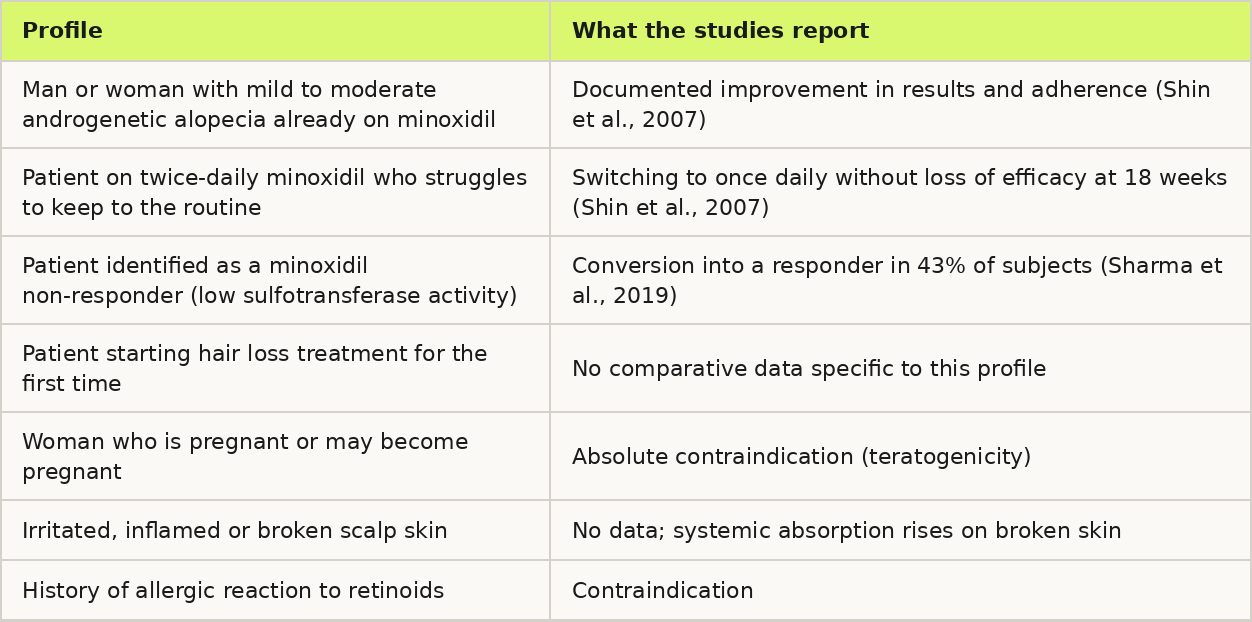
Which profiles have been studied?
Profiles covered in the literature
How is minoxidil responder status assessed?
Sharma et al. (2019) describe the Minoxidil Response Test (MRT), an in vitro test carried out on hairs removed by traction. It measures follicular sulfotransferase activity: a value below 0.4 indicates activity too low to respond to topical minoxidil. The test is 97.8% accurate at identifying non-responders. Where it is available, it can guide the decision to add tretinoin from the start of treatment in patients with low enzyme activity.
How long before results show?
The available studies span durations of 5 days (for the effect on sulfotransferases) up to 1 year (for photographically documented regrowth). The usual rule in trichology applies: first visible results are generally expected after 3 to 6 months of consistent treatment, and objective assessment takes 12 to 18 months.
Conclusion
Topical tretinoin combined with minoxidil is one of the best documented combinations for optimising the treatment of androgenetic alopecia.
The essentials:
- It works through three complementary mechanisms: upregulation of follicular sulfotransferases, greater skin absorption of minoxidil, and direct effects on the biology of the hair follicle (Sharma et al., 2019; Shin et al., 2007; Bazzano et al., 1986)
- At 0.01% alongside 5% minoxidil, a single daily application proved as effective as two applications of minoxidil alone, a direct advantage for adherence (Shin et al., 2007)
- It converts 43% of minoxidil non-responders into responders after just 5 days of 0.1% treatment (Sharma et al., 2019)
- Its tolerability on the scalp is good at the concentrations studied (0.01% to 0.025%), with mild and transient adverse effects
- It is contraindicated in pregnancy and calls for proper sun protection
For patients on minoxidil whose progress has stalled, or for those who struggle to keep up two applications a day, topical tretinoin is currently the most scientifically robust hair adjunct available. Building it into an androgenetic alopecia treatment protocol is a clinically justified decision, to be discussed with a dermatologist.
References
- Sharma A. et al. Tretinoin enhances minoxidil response in androgenetic alopecia patients by upregulating follicular sulfotransferase enzymes. Dermatologic Therapy. 2019;32:e12915.
- Shin H.S. et al. Efficacy of 5% Minoxidil versus Combined 5% Minoxidil and 0.01% Tretinoin for Male Pattern Hair Loss. Am J Clin Dermatol. 2007;8(5):285–290.
- Bazzano G.S. et al. Topical tretinoin for hair growth promotion. J Am Acad Dermatol. 1986;15:880–883.


How does tretinoin work?
Tretinoin acts on hair regrowth through three separate, complementary mechanisms, which is what makes it such a useful adjunct in treating androgenetic alopecia.
Mechanism 1: upregulation of follicular sulfotransferases
This is the central finding of Sharma et al. (2019). Minoxidil is not active in its raw form: it has to be converted into minoxidil sulfate by enzymes called sulfotransferases, located in the outer root sheath of the hair follicle. How active those enzymes are varies from person to person, and that variability explains why only 30 to 40% of patients respond to topical minoxidil.
Tretinoin acts on the RXR nuclear receptors, which govern sulfotransferase expression. By activating those receptors, it increases enzyme production in the follicle and therefore how efficiently minoxidil is converted (Sharma et al., 2019).
Mechanism 2: greater skin absorption of minoxidil
Tretinoin alters the stratum corneum barrier, which makes the skin more permeable to minoxidil. An earlier study found that percutaneous absorption of 2% minoxidil was roughly tripled in the presence of 0.05% tretinoin (Ferry et al., 1990, cited in Shin et al., 2007).
Mechanism 3: direct effects on follicular biology
Tretinoin stimulates the signalling pathways involved in hair growth: it activates the Erk and Akt pathways, prevents apoptosis through the Bcl-2/Bax ratio, and promotes vascular proliferation around the follicle (Shin et al., 2007; Bazzano et al., 1986).