

What is oral minoxidil?
Minoxidil has an unusual history. Developed in the 1970s as a potent vasodilator for severe, treatment-resistant hypertension, it quickly revealed an unexpected side effect in patients: hair regrowth and widespread hypertrichosis. That accidental discovery led to the development of topical minoxidil, launched in 1986 (Randolph & Tosti, JAAD, 2020).
The oral form is now enjoying a real resurgence of interest. Unlike the blood-pressure doses of 10 to 40 mg/day, low-dose oral minoxidil (LDOM) for hair loss is used at between 0.25 mg and 5 mg per day — up to 80 times lower. At those concentrations, the safety profile is radically different and well documented (Akiska et al., JAMA Dermatology, 2025).
One useful point: oral minoxidil isn't approved by the French HAS for treating hair loss. It's an off-label prescription. Even so, the practice is guided by an international consensus of 43 alopecia specialists published in JAMA Dermatology in 2025, offering clear recommendations on clinical use.
.avif)
Le minoxidil est-il efficace ?
Téléchargez le dernier livre blanc sur l'efficacité du Minoxidil sur les hommes atteints d'alopécie andro-génétique.
What's the recommended dose?
The 2025 international Delphi consensus published in JAMA Dermatology (Akiska et al.) brings together 43 dermatology experts from 12 countries. It sets out dosing recommendations tailored to sex and age:
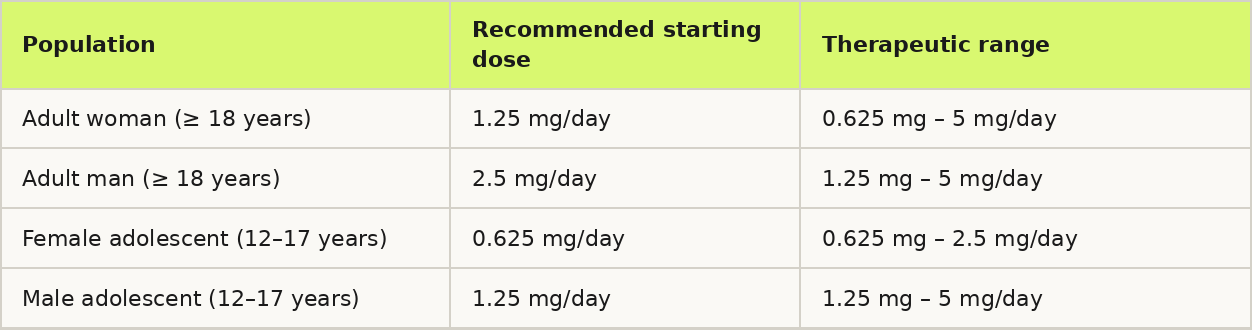
These doses reflect the most common practices among the experts surveyed. They explicitly stress that the dose must be individualised, based on:
- The patient's sex and age
- How severe the hair loss is
- How acceptable hypertrichosis is as a side effect
- The risk of systemic side effects
Gradual titration is possible. Patients who tolerate their dose well can discuss an increase with their doctor, weighing the benefit-to-risk ratio (Akiska et al., JAMA Dermatology, 2025).
Is oral minoxidil effective?
Male and female androgenetic alopecia
AGA is the best-documented indication for oral minoxidil. The 43-expert consensus reached very strong agreement (97.7%) that oral minoxidil can bring direct benefit in both male and female AGA, as well as in age-related hair loss (Akiska et al., JAMA Dermatology, 2025).
In the review by Randolph & Tosti (JAAD, 2020) — 16 studies covering 622 patients — oral minoxidil is shown to be effective on AGA at varying doses. In men, doses of 2.5 to 5 mg/day are the most effective. In women, lower doses (0.25 to 1.25 mg/day) are well tolerated and clinically effective.
In the Panchaprateep & Lueangarun study of 30 men treated with 5 mg/day for 24 weeks: 100% improvement in the vertex area, with 43% of results rated "remarkable" by an expert panel (cited in Randolph & Tosti, JAAD, 2020).
Other indications
Beyond AGA, the international consensus recognises that oral minoxidil can also benefit other forms of alopecia (Akiska et al., JAMA Dermatology, 2025):
Documented direct benefit (> 79% expert agreement):
- Telogen effluvium (86%)
- Traction alopecia (79%)
- Persistent chemotherapy-induced alopecia (83.7%)
- Alopecia areata (81.4%)
- Endocrine-therapy-induced alopecia (83.7%)
Supportive benefit in scarring alopecias:
- Lichen planopilaris (88.4%)
- Frontal fibrosing alopecia (88.4%)
- Central centrifugal cicatricial alopecia (86%)
When to expect the first results?
The expert consensus agrees on the following (Akiska et al., JAMA Dermatology, 2025):
- First visible results: at the earliest 3 months into treatment
- In the case of initial shedding (a transient shed at initiation): efficacy may only become visible at 6 months
Oral or topical minoxidil?
That's the central question in the Penha et al. study published in JAMA Dermatology in June 2024 — the first randomised, double-blind clinical trial directly comparing oral minoxidil 5 mg/day with topical minoxidil 5% twice a day, in 90 men with AGA over 24 weeks.
Hair density results:
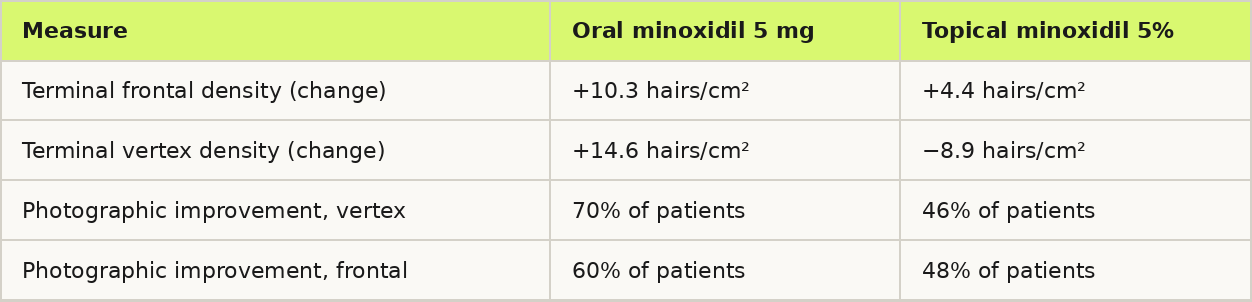
On the vertex, oral minoxidil is statistically superior to the topical form on photographic assessment (24% difference, p = 0.04). In the frontal area, the oral form is also more effective, but the difference isn't statistically significant (Penha et al., JAMA Dermatology, 2024).
On raw hair-density measures (trichoscopic counting), the oral form shows higher efficacy than the topical form. The difference doesn't reach the statistical significance threshold, but the observed trend clearly leans towards oral administration.
Cardiovascular tolerability
No significant difference in heart rate or blood pressure was found between the two groups. No patient reported dizziness, fainting or hypotension (Penha et al., JAMA Dermatology, 2024).
Practical takeaway
Oral minoxidil at 5 mg is not inferior to topical 5% in men, with possible superiority at the vertex. For patients who want to avoid the drawbacks of the topical form (residue, texture, irritation), oral minoxidil is a better-tolerated therapeutic alternative in daily use.
Oral minoxidil side effects
Hypertrichosis: the most common side effect
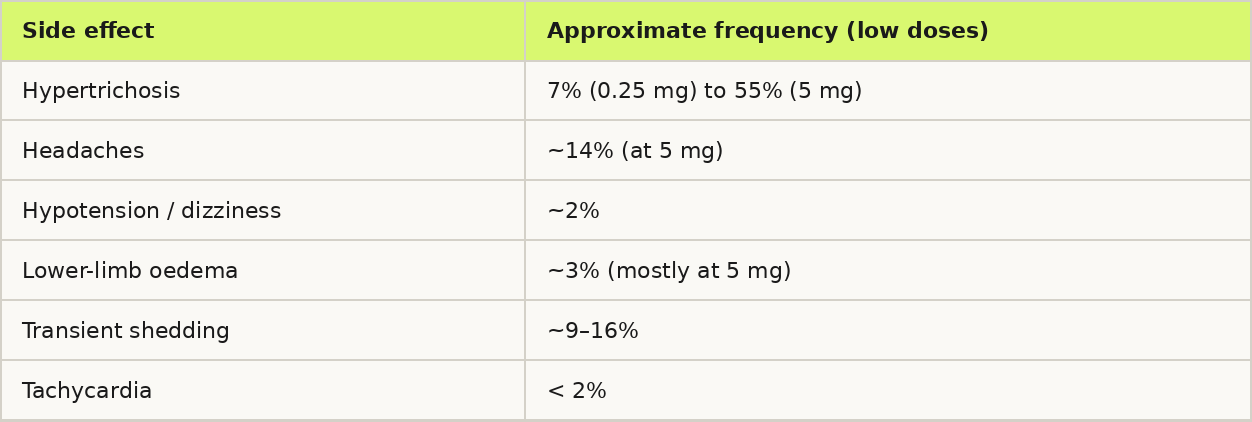
Hypertrichosis — hair growth on the face and body — is by far the most reported adverse effect. It's dose-dependent: a 1 mg increase in the dose raises the risk of hypertrichosis by 17.6% (Gupta et al., Journal of Dermatological Treatment, 2022).
In the Randolph & Tosti review (JAAD, 2020) of 571 patients:
- At 0.25 mg: 6.8% hypertrichosis
- At 1 mg: 21% hypertrichosis
- At 2.5 mg: 52% hypertrichosis
- At 5 mg: 55% hypertrichosis
Across nearly all studies, hypertrichosis is described as mild, well tolerated and rarely a reason to stop treatment. In the Penha et al. trial (JAMA Dermatology, 2024), of the 22 out of 45 patients who developed hypertrichosis on oral 5 mg, none stopped treatment because of it.
Cardiovascular effects: rare and mild at low dose
At low doses, cardiovascular effects are rare (Randolph & Tosti, JAAD, 2020):
- Orthostatic hypotension / dizziness: around 2% of patients
- Lower-limb oedema: around 3% of patients (mostly at 5 mg)
- Mild ECG changes: under 1% of cases
No serious cardiopulmonary event has been reported in low-dose studies. The Penha et al. trial (JAMA Dermatology, 2024) confirms: no significant change in heart rate or blood pressure at 24 weeks on 5 mg/day in healthy young men.
Transient telogen effluvium
As with the topical form, oral minoxidil can cause a transient shed at initiation, due to hairs entering the telogen phase prematurely. It usually lasts 3 to 6 weeks and settles on its own. The expert consensus confirms that the shedding risk with the oral form is comparable to the topical form (Akiska et al., JAMA Dermatology, 2025). Informing patients about this is essential, to avoid stopping treatment too early.
Headaches
Headaches are more common with the oral form than with the topical form. In the Penha et al. study (JAMA Dermatology, 2024): 14% of patients on oral vs 2% on topical.
Summary table of oral minoxidil side effect
How do I know if I'm a good candidate for oral minoxidil?
Who can benefit from oral minoxidil?
The international consensus (Akiska et al., JAMA Dermatology, 2025) recommends considering oral minoxidil for adults and adolescents (12–17 years) with:
- Male or female androgenetic alopecia
- Chronic telogen effluvium
- Alopecia areata
- Traction alopecia
- Scarring alopecias (as adjunct)
Oral minoxidil is particularly preferable to the topical form in the following situations (consensus ≥ 86%):
- The topical form changes hair texture or leaves an unwanted greasy residue (95.5% agreement)
- The topical form worsens scalp inflammation (93.2%)
- The topical form is less practical or more expensive (93.2%)
- The topical form has been insufficient or has lost efficacy (90.9%)
- Additional hypertrichosis is desired (e.g. transgender patients, 86.4%)
Absolute contraindications
The experts agree on the following contraindications (Akiska et al., JAMA Dermatology, 2025):
- Pregnancy or breastfeeding (95.5% agreement)
- Congestive heart failure
- History of pericardial effusion or tamponade
- History of pericarditis
- Pulmonary hypertension associated with mitral stenosis
- Phaeochromocytoma
- Significant drug interactions
Precautions (specialist consultation recommended)
- History of tachycardia or arrhythmia
- Hypotension (BP < 90/60 mmHg)
- Renal impairment or dialysis
Baseline work-up
For patients without risk factors, no routine laboratory tests or ECG are required before starting low-dose oral minoxidil (90.7% and 93% expert agreement respectively). These tests are only recommended when a precaution has been identified, in coordination with a cardiologist or the treating physician (Akiska et al., JAMA Dermatology, 2025).
Conclusion
Low-dose oral minoxidil is a meaningful clinical step forward in managing alopecia. Backed by an international consensus of 43 experts and validated by randomised clinical trials, it offers:
- Efficacy comparable to, or slightly greater than, topical minoxidil 5%, particularly on the vertex
- A favourable safety profile at low dose in patients without cardiovascular comorbidities
- Better adherence, thanks to a single daily oral intake
- A credible alternative for patients intolerant to the topical form or non-responders
The main limitations are hypertrichosis (dose-dependent, generally well tolerated) and the need for medical follow-up — particularly where cardiovascular risk factors are present. Off-label prescribing calls for a relationship of trust with a competent healthcare professional.
References
- Akiska YM, Mirmirani P, Roseborough I, et al. Low-Dose Oral Minoxidil Initiation for Patients With Hair Loss: An International Modified Delphi Consensus Statement. JAMA Dermatology. 2025;161(1):87–95.
- Penha MA, Miot HA, Kasprzak M, Müller Ramos P. Oral Minoxidil vs Topical Minoxidil for Male Androgenetic Alopecia: A Randomized Clinical Trial. JAMA Dermatology. 2024;160(6):600–605.
- Randolph M, Tosti A. Oral minoxidil treatment for hair loss: A review of efficacy and safety. Journal of the American Academy of Dermatology. 2021;84(3):737–746.
- Gupta AK, Talukder M, Williams G. Comparison of oral minoxidil, finasteride, and dutasteride for treating androgenetic alopecia. Journal of Dermatological Treatment. 2022;33(7):2946–2962.
How does oral minoxidil work?
Absorption and metabolism
After ingestion, about 90% of minoxidil is absorbed through the gut. Peak plasma concentration is reached in around 1 hour, and the plasma half-life is around 4 hours — though its effect on the follicles lasts several days, up to 72 hours (Gupta et al., Journal of Dermatological Treatment, 2022).
Minoxidil is a prodrug: it's in the liver that it's converted into minoxidil sulfate, its biologically active form, chiefly via glucuronidation, hydroxylation and sulfation. It's this sulfated form that stimulates the hair follicles.
💡 Key difference from the topical form: topical minoxidil is converted locally in the outer root sheath of the follicle by sulfotransferase enzymes. This process depends on how much of these enzymes is present in the patient's scalp — which explains why some people respond poorly to the topical form. Oral minoxidil bypasses this step by being sulfated directly in the liver, which can make it effective even in topical "non-responders" (Randolph & Tosti, JAAD, 2020).
Mechanisms of action on the follicle
Minoxidil works through several complementary pathways (Gupta et al., Journal of Dermatological Treatment, 2022):
In short: minoxidil lengthens the anagen phase, shortens the telogen phase, increases follicle diameter and improves hair density. The effect is suspensive: once treatment stops, hair loss gradually picks up again.