

What is microneedling?
Microneedling is a technique of percutaneous mechanical stimulation through micro-perforations of the scalp, carried out with needles of 0.25 to 5.00 mm. Described in 1995 by Orentreich for atrophic scars and wrinkles, it moved to the scalp during the 2010s, with a pivotal study published in 2013 by Dhurat et al. on its efficacy alongside 5% minoxidil in androgenetic alopecia.
What sets microneedling apart from other hair approaches is that it is purely mechanical: it introduces no external compound, does not act on DHT and does not alter the hormonal profile. It works on follicle biology by setting off tissue repair cascades.
The systematic review by English et al. (2022) analysed 22 clinical studies covering 1,127 subjects (856 men, 269 women), across androgenetic alopecia (n = 911), alopecia areata (n = 201), alopecia totalis (n = 8) and telogen effluvium (n = 7). It remains the most complete synthesis available on the subject.
.avif)
Le finastéride est-il efficace ?
Téléchargez le dernier guide sur l'efficacité du Finastéride sur les hommes atteints d'alopécie andro-génétique.
How does microneedling work?
Microneedling acts on hair regrowth through three separate, complementary mechanisms.
Mechanism 1: activation of the Wnt/β-catenin pathway
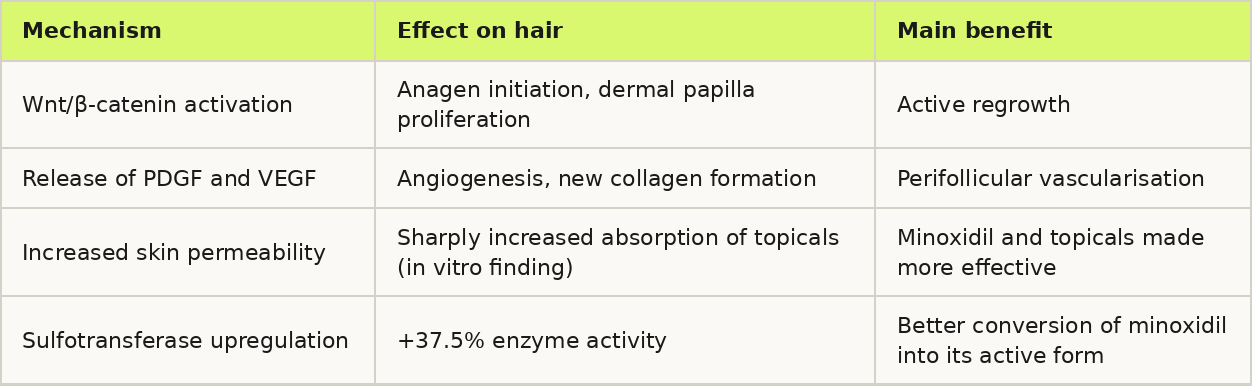
In androgenetic alopecia, DHT disrupts the Wnt/β-catenin pathway, shortens the anagen phase and triggers apoptosis of dermal papilla cells. Microneedling pushes back: the micro-injuries activate follicular stem cells and stimulate production of PDGF and VEGF. Those signals set off angiogenesis, new collagen formation and entry into a fresh anagen cycle (English et al., 2022).
Work in animal models has confirmed that percutaneous micro-punctures stimulate hair follicle regeneration through the Wnt pathway, the very one DHT inhibits in androgenetic alopecia.
Mechanism 2: increased skin permeability
This is the mechanism with the most direct practical use. Henry et al., cited in English et al. (2022), showed in vitro, on human skin, that 0.15 mm needles inserted for 10 seconds increase skin permeability more than 1,000-fold. That figure comes from a laboratory model and from a needle length far below what is used on the scalp; it illustrates the mechanism rather than transferring directly to practice. It does explain why microneedling improves the absorption of topical treatments.
Mechanism 3: upregulation of follicular sulfotransferases
This mechanism creates a direct link with minoxidil. Sharma et al., cited in English et al. (2022), showed that 21 days of weekly microneedling raise median follicular sulfotransferase activity by 37.5%. That enzyme is what converts minoxidil into its active form, minoxidil sulfate, and a shortfall in it explains non-response to topical minoxidil in 60 to 70% of patients. This is a laboratory-measured biological marker, not a clinical outcome: no published data show that the rise in enzyme activity translates into regrowth in patients who do not respond to minoxidil.
The mechanisms at a glance
Does microneedling work on its own?
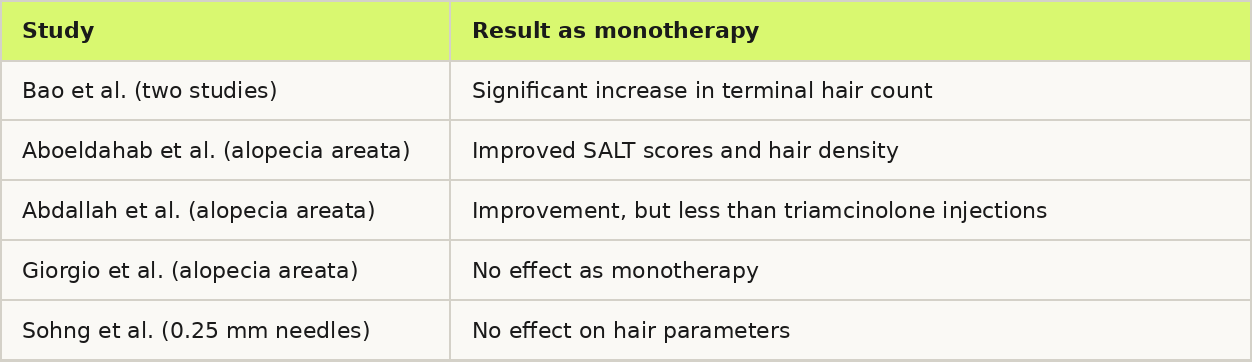
This is the most honest question to ask, and the answer deserves nuance. Of the 22 studies in the review by English et al. (2022), 6 treatment groups assessed microneedling as monotherapy, covering 105 subjects in total. The results are mixed.
What that means in practice
Microneedling on its own can produce some regrowth in androgenetic alopecia, but the data are not strong enough to make it a standalone first-line treatment. The authors point out that the studies are of limited methodological quality, with a mean Jadad score of 2 out of 5, small samples and durations often under 12 months, which makes it hard to separate a real effect from seasonal swings in the hair cycle (English et al., 2022).
On the evidence available, microneedling is more convincing as an adjunct than as monotherapy.
Does microneedling work alongside a topical treatment?
This is where the data become firmer. Microneedling combined with a topical treatment accounts for most of the clinical evidence available.
Microneedling and 5% minoxidil
Of the 7 studies testing this combination, 6 found statistically significant increases in hair count compared with minoxidil alone (English et al., 2022). Those studies used different devices and needle lengths from 0.60 to 2.50 mm, a factor of 4: there is no standardised protocol, and the results are not directly comparable with one another.
The trial by Dhurat et al. (2013), cited in English et al. (2022), is a randomised assessor-blinded pilot study, not a double-blind one. Its Jadad score of 3 out of 5 is the highest in the review, but that figure hits a structural ceiling with this kind of design. The trial showed in 100 men with androgenetic alopecia that weekly microneedling alongside twice-daily 5% minoxidil significantly increased hair count compared with minoxidil alone, with better photographic assessments and self-assessments in the combined group.
That finding has been replicated. Kumar et al. (2018) ran the same protocol — weekly microneedling alongside twice-daily 5% minoxidil, against 5% minoxidil alone — in 68 men at Hamilton stages III to IV. The superiority of the combination holds, but its size is far smaller: mean hair count gain was 12.5 ± 6.82 (n = 31) against 1.89 ± 8.94 (n = 29), where Dhurat reported 91.40 ± 49.27 (n = 50) against 22.20 ± 19.34 (n = 44). On self-assessment, 4 participants out of 31 reported at least 50% improvement, against 41 out of 50 in Dhurat. The authors conclude that the response obtained, though statistically superior, is not cosmetically significant.
They put forward two explanations for the gap with Dhurat: hair-counting procedures differed between the two trials, and scalp shaving, mandatory in Dhurat, was not required in their own protocol. The two trials are therefore not directly comparable, and part of the difference in magnitude comes down to method.
Results in patients at a treatment plateau
One clinically interesting finding concerns patients already on treatment whose progress has stalled. Burns et al., cited in English et al. (2022), added microneedling twice a month to ongoing treatment, 5% minoxidil included, in 11 women who had plateaued for at least 6 months: all 11 improved their Sinclair score by at least 1 to 1.5 points. The sample is 11 people and the study had no control group.
Starace et al., cited in English et al. (2022), showed that adding microneedling improved hair counts in patients who had been on treatment for more than a year.
Microneedling, PRP and growth factors
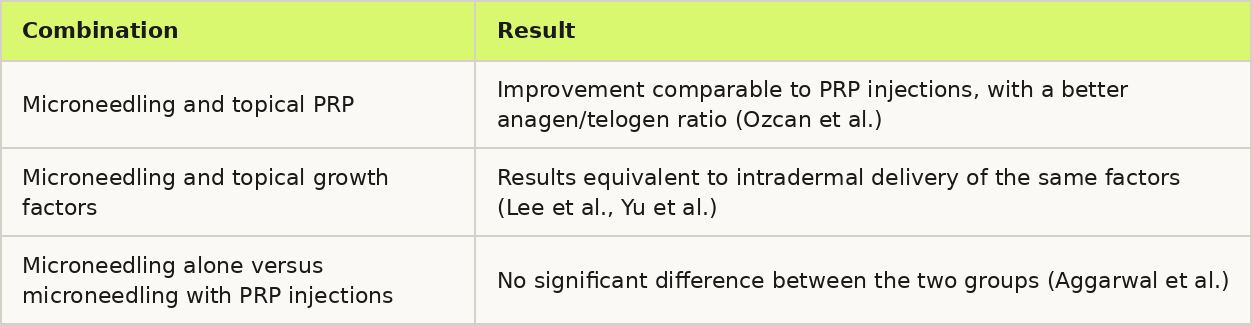
That last point stands out: it suggests microneedling improves the penetration of actives enough for topical PRP to give results comparable to intradermal injections. These comparisons rest on small samples, and the procedure remains a medical act.
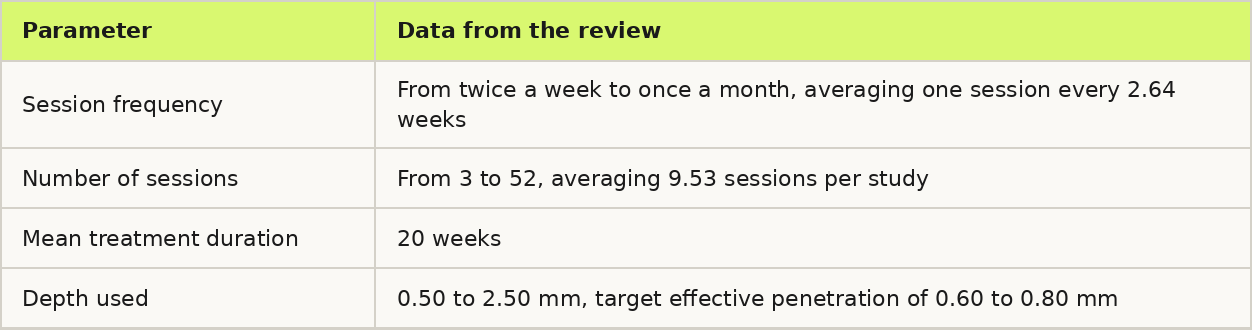
Session frequency and duration
Side effects of microneedling
In the studies analysed, the tolerability profile of microneedling is favourable. Across the 657 subjects who received microneedling in the review by English et al. (2022), no serious adverse effect was reported, and the side effects observed were all mild and transient.
What the studies report
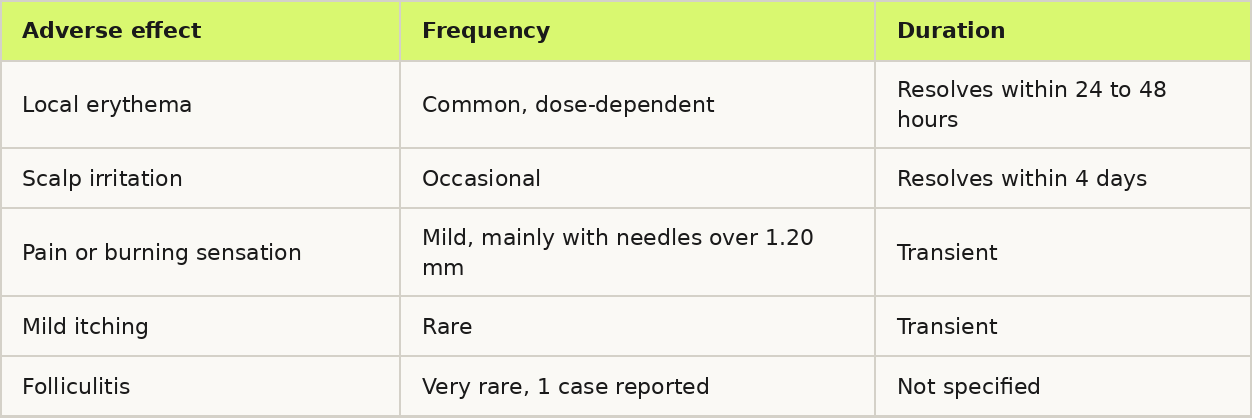
Dropout rates in the microneedling groups are low and comparable to control groups across all the studies, which confirms the procedure is well accepted (English et al., 2022).
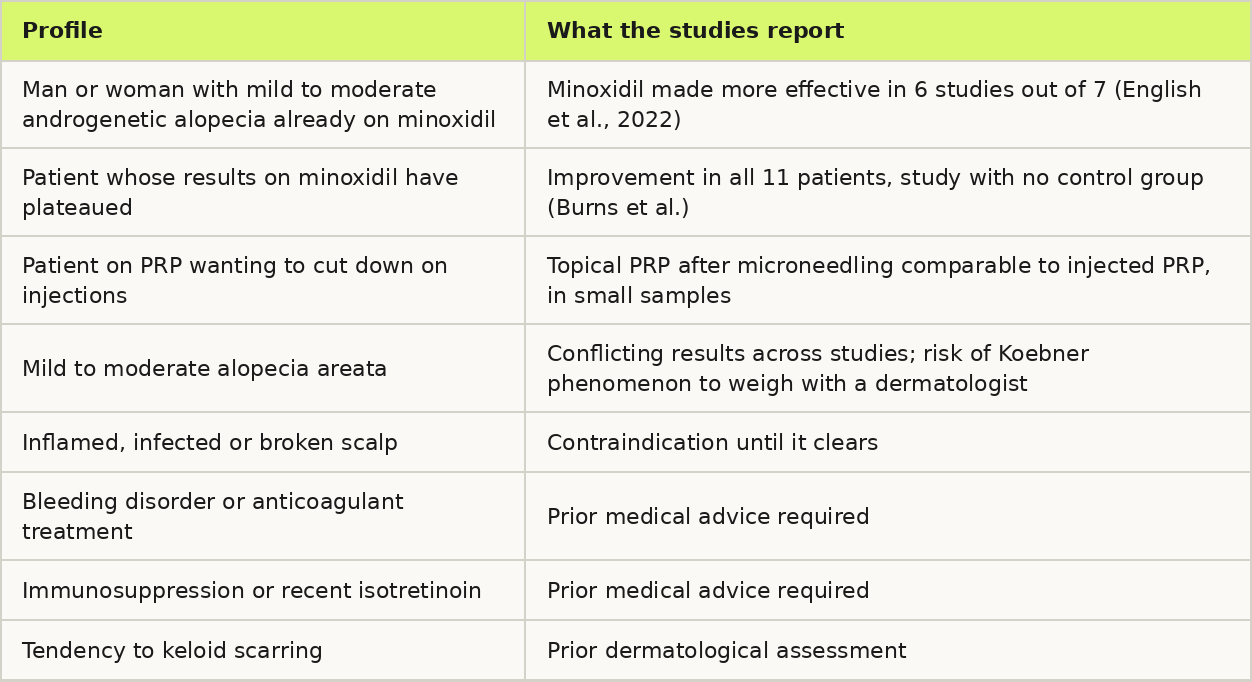
⚠️ Practical precautions. Microneedling should be avoided on an inflamed, infected or broken scalp, in active skin infection or herpes, in bleeding disorders or on anticoagulant treatment, in immunosuppression, with a tendency to keloid scarring, and after recent isotretinoin treatment. Hygiene must be strict and needle cartridges changed regularly; a device is never shared. Do not apply minoxidil or any other topical straight after a session: the skin barrier is open and systemic absorption is increased. Published protocols allow a 24-hour gap.
Which profiles have been studied?
Profiles covered in the literature
Conclusion
Microneedling is currently the best documented mechanical adjunct in the treatment of androgenetic alopecia. It improves hair parameters on its own in some cases, but the data are strongest when it is combined with topical treatments, minoxidil first among them.
The essentials:
- 6 studies out of 7 testing microneedling alongside 5% minoxidil show results significantly better than minoxidil alone (English et al., 2022)
- It works through three complementary mechanisms: Wnt/β-catenin activation, increased skin permeability, and upregulation of follicular sulfotransferases by 37.5%
- The most favourable effective penetration depth sits around 0.60 to 0.80 mm, whatever the nominal needle length
- In patients at a treatment plateau, a study with no control group covering 11 women reports improvement in all 11 participants
- No serious adverse effect was reported across the 657 treated subjects in the review
- The data remain of moderate methodological quality, with a mean Jadad score of 2 out of 5: large randomised trials over at least 12 months are needed before firm recommendations can be made
For patients on minoxidil who want to get the most out of their treatment or restart stalled results, microneedling is the most accessible, best tolerated and most solidly documented adjunct. Building it into a hair protocol is a clinically justified decision, to be taken and supervised with a dermatologist specialising in trichology.
References
- English R.S. Jr., Ruiz S., DoAmaral P. Microneedling and Its Use in Hair Loss Disorders: A Systematic Review. Dermatol Ther (Heidelb). 2022;12:41–60.
- Kumar M.K., Inamadar A.C., Palit A. A Randomized Controlled, Single-Observer Blinded Study to Determine the Efficacy of Topical Minoxidil plus Microneedling versus Topical Minoxidil Alone in the Treatment of Androgenetic Alopecia. J Cutan Aesthet Surg. 2018;11(4):211–216.
Which tools and which needle lengths?
The devices available
Across the 22 studies analysed by English et al. (2022), manual rollers (8 studies) and automated pens (7 studies) are the devices used most often.
The question of needle depth
This is one of the most debated points in the literature. In the studies included by English et al. (2022), needle lengths tested range from 0.25 mm to 2.50 mm, with a mean length of 1.39 mm. But needle length is not the same thing as actual penetration depth.
The authors note that a 3.00 mm manual roller penetrates only 50 to 70% of the nominal needle length, because pressure and insertion angle vary. Automated pens, by contrast, reach depths close to the setting used, up to 1.50 mm (English et al., 2022).
Why avoid needles that are too long?
Faghihi et al., cited in English et al. (2022), compared two needle lengths, 0.60 mm and 1.20 mm, alongside 5% minoxidil, and obtained better results on hair density and diameter with 0.60 mm. The explanation offered: a depth of 0.60 mm produces enough of an inflammatory response to recruit stem cells and growth factors without damaging the follicular bulge, which sits 1.00–1.80 mm below the skin surface. Longer needles risk reaching and injuring that zone.
⚠️ What the data suggest. On the scalp, an effective penetration depth of 0.60 to 0.80 mm comes out as the most favourable target in the available studies, whatever the nominal needle length. These figures describe research protocols: choosing a device and a depth is a matter for medical advice, not a setting to work out alone.