

What is latanoprost?
Latanoprost is a synthetic analogue of prostaglandin F2α (PGF2α), sold at 0.005% as eye drops for open-angle glaucoma and ocular hypertension. Its local side effect profile, in particular eyelash hypertrichosis along with longer, thicker and darker lashes, caught the attention of trichologists in the early 2000s.
Those ophthalmic observations led to a simple hypothesis: if latanoprost stimulates eyelash follicles, could it do the same for scalp follicles? Preclinical studies in macaque monkeys and mice confirmed hair regrowth after local application of latanoprost. They opened the way to the first clinical trials in humans (Blume-Peytavi et al., 2012).
What sets latanoprost apart from other hair loss treatments is its prostaglandin pathway, entirely independent of the androgen/DHT axis. It does not inhibit 5-alpha-reductase and does not act on androgen receptors. It works directly on hair follicle biology through prostaglandin receptors.
.avif)
Le finastéride est-il efficace ?
Téléchargez le dernier guide sur l'efficacité du Finastéride sur les hommes atteints d'alopécie andro-génétique.
What concentration has been studied?
The only randomised clinical study available on topical latanoprost applied to the scalp in androgenetic alopecia used a concentration of 0.1%, 20 times the usual ophthalmic concentration (0.005%).
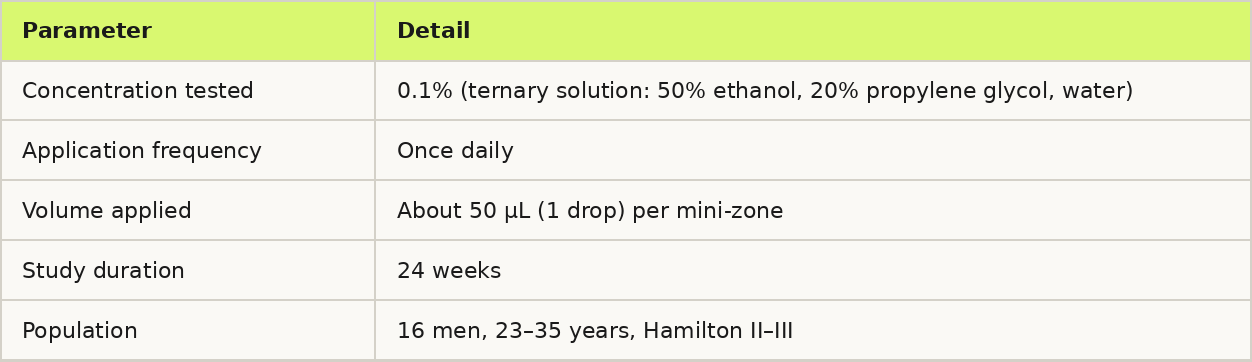
The authors note that this 0.1% concentration is 3.6 times lower than the intravenous dose tolerated in the available data, and is therefore considered to carry no significant systemic risk (Blume-Peytavi et al., 2012).
⚠️ Worth noting. The erythema seen in 5 patients out of 16 (31%) in the treated area led the authors to regard 0.1% as close to the maximum advisable dose. Future studies will need to establish the concentration that best combines efficacy and tolerability.
Does latanoprost work?
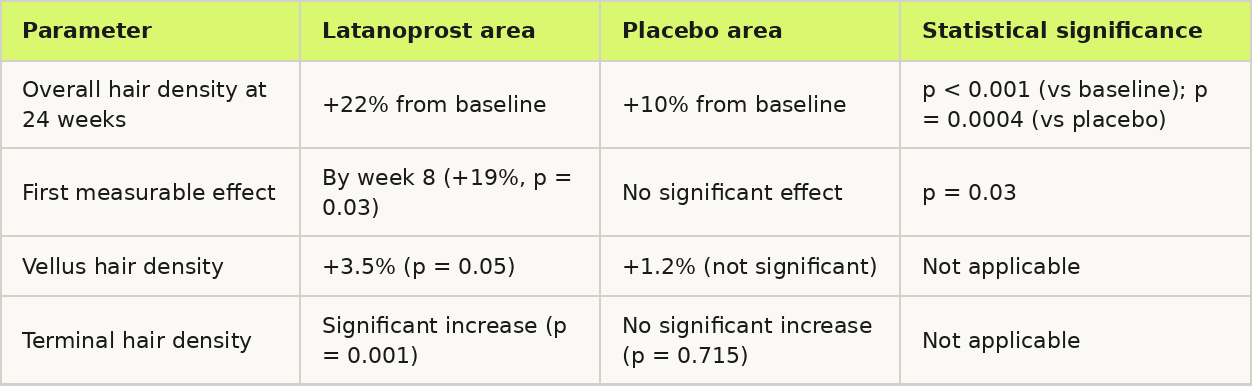
This is the central question in the randomised double-blind pilot study by Blume-Peytavi et al. (2012), run in 16 men with mild to moderate androgenetic alopecia (Hamilton II–III), each subject acting as his own control: one area treated with latanoprost, one area treated with placebo.
Quantitative results (TrichoScan)
Clinical results
On the global clinical assessment (density, length, thickness, pigmentation), the subjects broke down as follows (Blume-Peytavi et al., 2012):
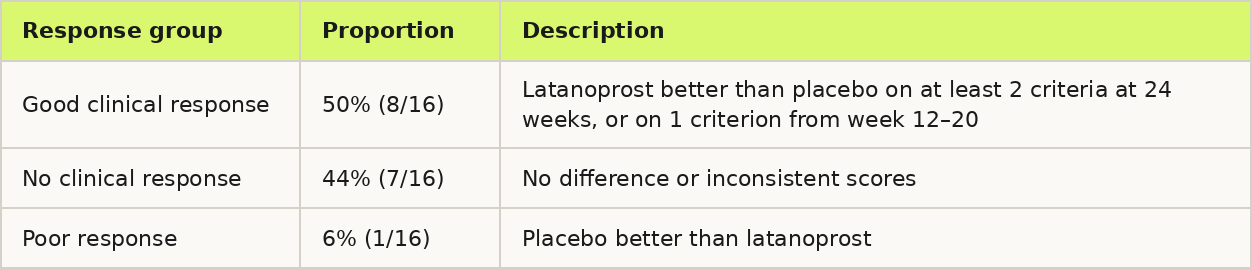
In responders, hair density is the first parameter to improve, usually between weeks 12 and 16, followed by thickness, length and pigmentation (Blume-Peytavi et al., 2012).
A distinct mechanism, a possible complement
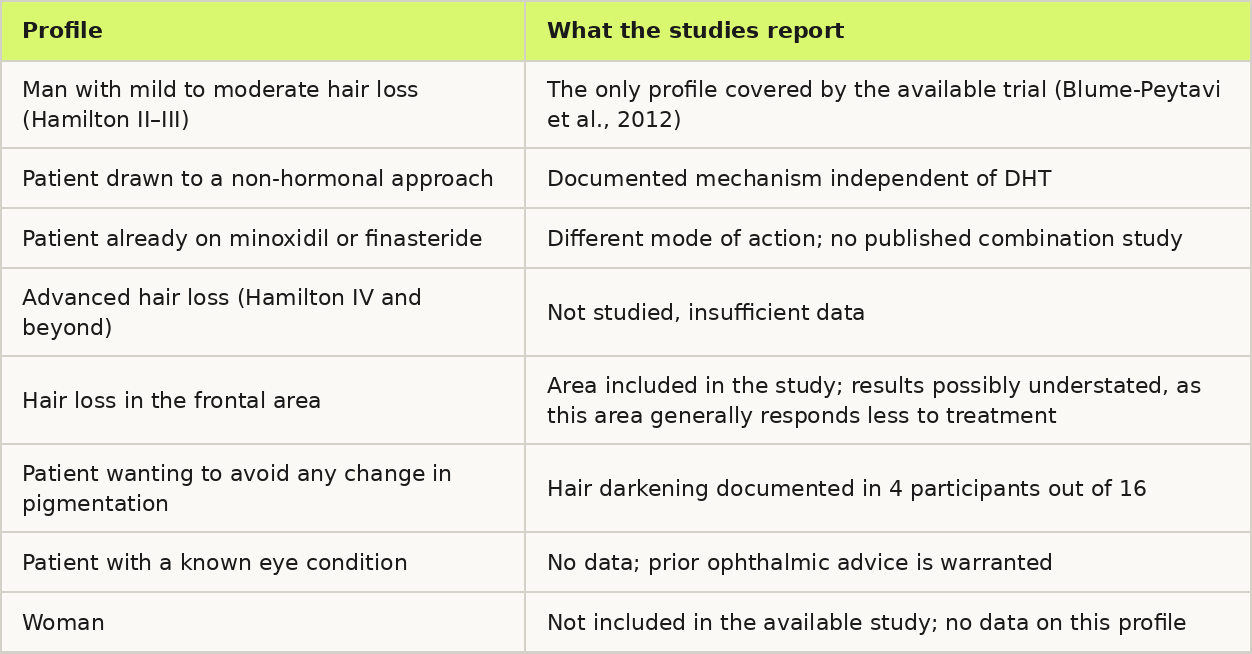
Because latanoprost does not act on the androgen pathway, it is in theory a candidate for combination with minoxidil or finasteride, since the two treatments hit different biological targets. This potential synergy has yet to be confirmed by dedicated clinical studies.
Side effects of latanoprost
The tolerability profile of topical latanoprost on the scalp is broadly acceptable, but it warrants attention, mainly because of the pigmenting effect.
What the study reports
Across 16 subjects followed for 24 weeks, 8 participants experienced a total of 9 skin-related adverse effects (Blume-Peytavi et al., 2012):
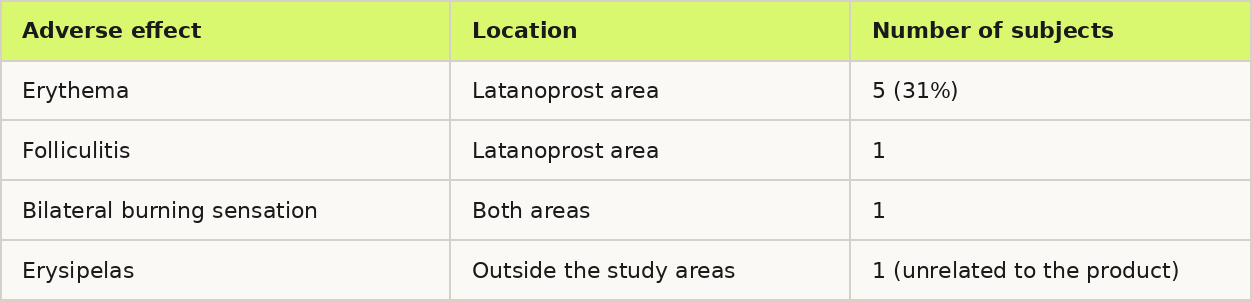
Erythematous reactions are the only ones the investigators considered potentially attributable to the product. All patients who developed erythema nonetheless responded well to treatment, which suggests the local inflammatory reaction did not compromise efficacy (Blume-Peytavi et al., 2012).
Specific risks worth knowing about
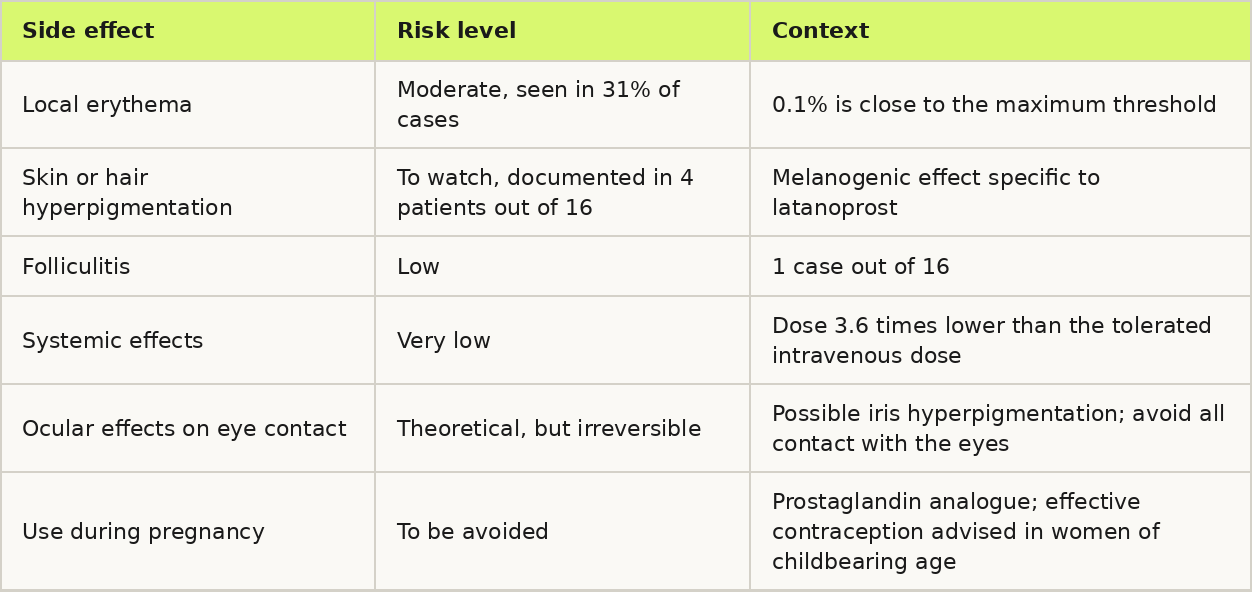
⚠️ The key point on pigmentation. Latanoprost has a documented melanogenic effect. On the scalp this can mean darkening of both the hair and the skin. The effect should be anticipated, particularly in patients with fair or greying hair. On eye contact, by contrast, iris hyperpigmentation is irreversible.
Which profiles have been studied?
Profiles covered in the literature
The study by Blume-Peytavi et al. (2012) was run exclusively in young men (23–35 years) with mild to moderate androgenetic alopecia (Hamilton II–III). That is the only profile for which clinical data exist.
When can results be expected?
The TrichoScan data show a first significant difference from placebo by week 8 of treatment. Perceptible clinical effects (density, thickness) generally appear between weeks 12 and 16 in responders. The available study ran for 24 weeks in total, with no data on whether the effects hold up after treatment stops (Blume-Peytavi et al., 2012).
Conclusion
Topical latanoprost is one of the most unusual and least known treatments in the arsenal against androgenetic alopecia. Its main interest lies in a mode of action radically different from every other available treatment.
The essentials:
- It increases hair density by 22% over 24 weeks, against 10% under placebo (p = 0.0004 versus placebo; p < 0.001 from baseline). The first significant difference from placebo appears by week 8 (p = 0.03; Blume-Peytavi et al., 2012)
- 50% of patients show a good overall clinical response (density, length, thickness, pigmentation)
- It works by recruiting new follicles into the growth cycle via prostaglandin receptors, a mechanism entirely distinct from minoxidil and finasteride
- It has a documented pigmenting effect on hair and scalp, to be weighed before starting treatment
- Its tolerability profile is broadly acceptable, with local erythema the most frequent adverse effect (31% of subjects at 0.1%)
- The available data remain limited: a single pilot trial in 16 young men with mild to moderate androgenetic alopecia, with no head-to-head comparison against minoxidil or finasteride
Topical latanoprost is a promising therapeutic avenue, particularly for patients drawn to a non-hormonal complementary approach, or for those who do not respond to conventional treatments. Where exactly it belongs still needs to be established by larger studies, but the current data justify raising it in a therapeutic discussion with a dermatologist specialising in trichology.
References
- Blume-Peytavi U. et al. A randomized double-blind placebo-controlled pilot study to assess the efficacy of a 24-week topical treatment by latanoprost 0.1% on hair growth and pigmentation in healthy volunteers with androgenetic alopecia. J Am Acad Dermatol. 2012;66:794–800.
How does latanoprost work?
The prostaglandin pathway in the hair follicle
Prostaglandins are lipid mediators that regulate a wide range of biological processes. Within the hair follicle, different prostaglandins pull the hair cycle in opposite directions:
As a PGF2α analogue, latanoprost activates the FP receptors present in follicular cells. It sets off a signalling cascade that supports follicular activity.
The follicle recruitment mechanism
The study by Blume-Peytavi et al. (2012) gives a precise picture: the TrichoScan data show that latanoprost increases the absolute number of hairs in both the anagen and the telogen phase, without significantly altering the anagen/telogen ratio. The authors read this as evidence that latanoprost recruits new follicles into the growth cycle rather than simply extending the anagen phase of existing ones.
Effects on pigmentation
One notable effect of latanoprost is its action on follicular melanogenesis. In the study, 4 participants out of 16 showed visibly increased hair pigmentation in the latanoprost-treated area, and 1 participant showed pigmentation of the scalp itself. This effect on hair colour, already well documented for eyelashes, therefore appears to carry over to the scalp (Blume-Peytavi et al., 2012).