

What is topical finasteride?
Topical finasteride grew out of a simple observation: oral finasteride works against androgenetic alopecia (AGA), but its sexual side effects (rare in controlled trials, yet not negligible) put many patients off. The idea of a local application was already around in the late 1990s, with one goal in mind: concentrate the drug's action where it's needed (the scalp) while limiting how much reaches the bloodstream.
The first clinical study of topical finasteride in men was published by Mazzarella et al. in 1997. It tested a 0.005% finasteride solution in 52 patients over 16 months and served as the initial proof of concept: a local application can reduce shedding and support regrowth, with no detectable systemic absorption (Mazzarella et al., 1997).
Concentrations have moved up since then, from 0.005% to 0.1%, then 0.25% and 1%, and the clinical evidence has grown much stronger, culminating in a randomised, double-blind phase III trial (Piraccini et al., 2022) that directly compared topical finasteride 0.25% with oral finasteride 1 mg over 24 weeks in 458 men.
Today, topical finasteride comes in several forms: hydroalcoholic solution, spray, gel. The most studied concentration, now considered optimal, is 0.25%, sometimes on its own and sometimes combined with topical minoxidil in a single solution.
One important caveat: like the oral form, topical finasteride doesn't cure AGA. It keeps the condition in check as long as the treatment continues. Once it stops, the follicles gradually become sensitive to DHT again.
.avif)
Le finastéride est-il efficace ?
Téléchargez le dernier guide sur l'efficacité du Finastéride sur les hommes atteints d'alopécie andro-génétique.
What's the recommended dose?
Topical finasteride has been tested across a wide range of concentrations since the 1990s. The way clinical data have accumulated now lets us pinpoint the optimal concentration.
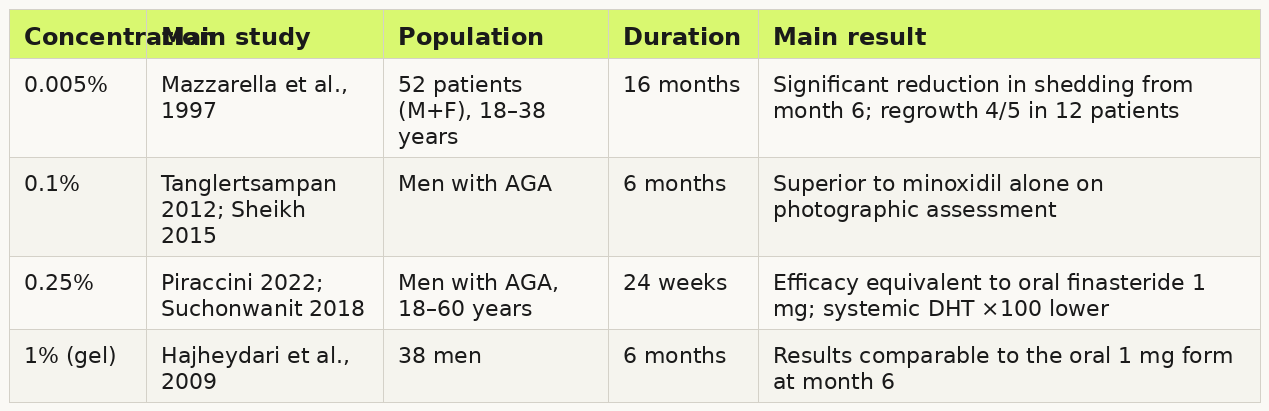
0.25% is now considered the optimal concentration for maximising follicular effect while minimising systemic absorption. Phase I–II pharmacokinetic studies (Caserini et al., 2014 and 2016, cited in Piraccini et al., 2022) showed that daily application of 0.25% produced scalp and plasma DHT reductions equivalent to those of oral finasteride 1 mg, with plasma exposure roughly 9 times lower in those early studies — a figure that grew to more than 100 times in the phase III trial by Piraccini et al. (2022).
Is topical finasteride effective?
Topical finasteride 0.005% vs placebo (Mazzarella et al., 1997)
The first clinical proof of efficacy for topical finasteride in men dates back to 1997. In this single-blind, placebo-controlled study, 52 patients (28 men and 24 women, aged 18 to 38) applied 1 mL of either a 0.005% finasteride solution or the vehicle alone twice a day for 16 months (Mazzarella et al., 1997).
Regrowth results (6-point scale):
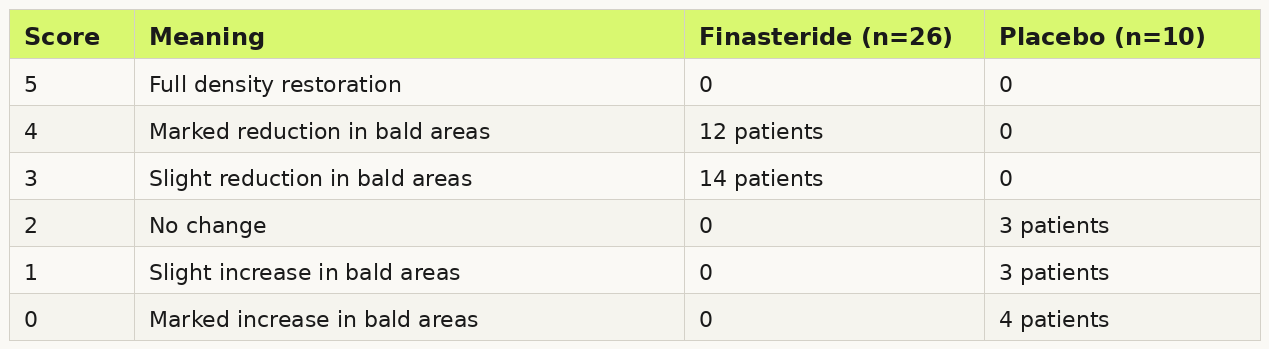
Every patient on finasteride scored either 3 or 4 (slight to marked improvement), whereas placebo results ran from marked deterioration to no change. 73% of the finasteride patients rated their treatment as "very effective" (score 3/3), against a majority of 0–1 scores in the placebo group (Mazzarella et al., 1997).
Shedding results (bimonthly wash test):
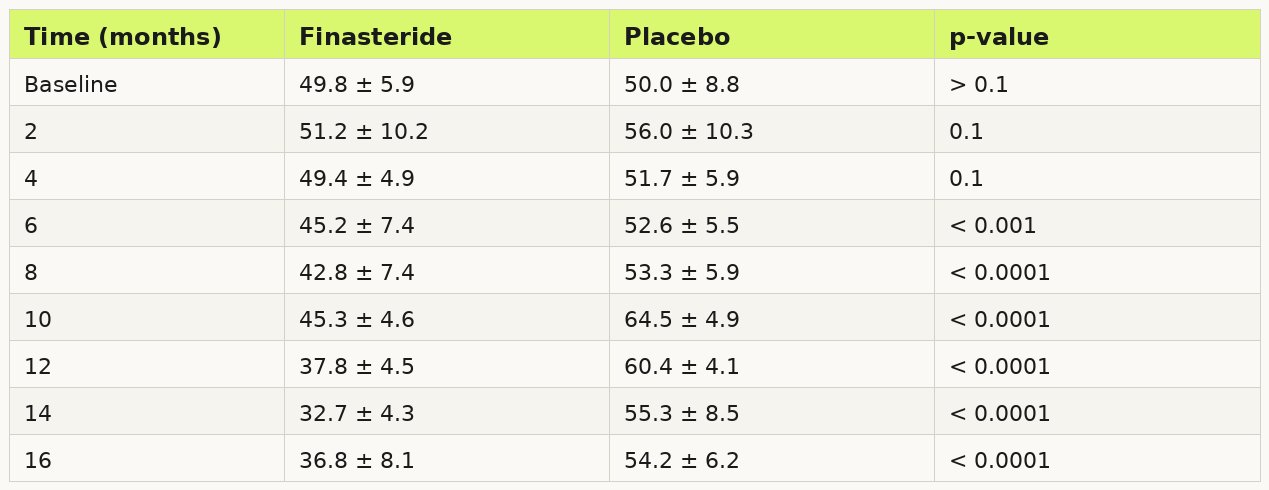
From month 6, the gap between the two groups becomes significant and widens steadily through to the end of the study. The finasteride group's shedding drops steadily, while the placebo group's climbs (Mazzarella et al., 1997).
Worth noting: no change was seen in plasma levels of total testosterone, free testosterone or DHT in the finasteride group, which rules out any meaningful systemic absorption at this low concentration (Mazzarella et al., 1997).
Topical finasteride 0.25% vs placebo and vs oral finasteride (Piraccini et al., 2022)
The phase III trial by Piraccini et al. (2022) is the most rigorous study on topical finasteride to date. It randomised 458 men with Hamilton–Norwood III vertex to V AGA in a double-blind, double-dummy design, in a 2:2:1 ratio between topical finasteride 0.25% (spray, 1 to 4 sprays a day), placebo, and oral finasteride 1 mg over 24 weeks.
Hair efficacy (hair gain in the target area, 1 cm²):

* p < 0.001 vs placebo; ** p < 0.005 vs placebo (Piraccini et al., 2022).
Investigator assessment (7-point scale, −3 to +3):

* p < 0.001 vs placebo; ** p < 0.005 vs placebo (Piraccini et al., 2022).
Patient assessment (MHGQ, 7-item questionnaire, % responders):
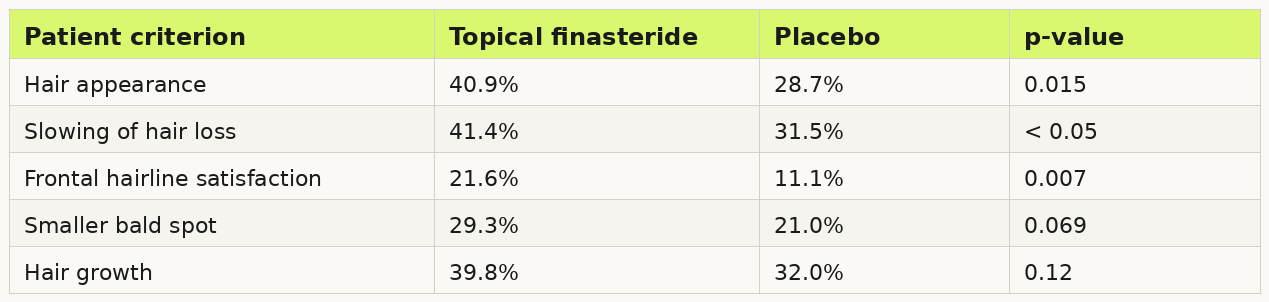
Of the 6 patient self-assessment criteria, 3 reach statistical significance in favour of topical finasteride vs placebo (Piraccini et al., 2022).
Topical finasteride 0.25% + minoxidil 3% vs minoxidil 3% alone (Suchonwanit et al., 2018)
This double-blind randomised study enrolled 40 men aged 18 to 60 with Hamilton–Norwood III vertex to V AGA, split evenly between a combined 0.25% finasteride + 3% minoxidil solution (FMX group) and a 3% minoxidil-only solution (MX group), applied twice a day for 24 weeks.
Efficacy on hair density (trichoscopy, hairs/cm²):
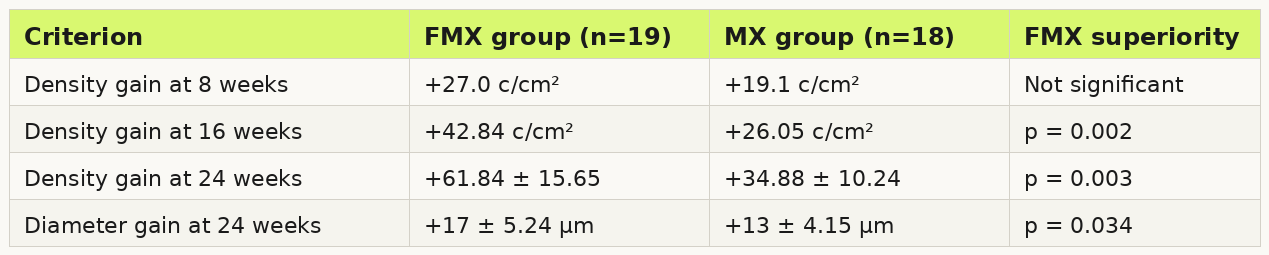
At 24 weeks, the combined solution delivers about 27 hairs/cm² more than minoxidil alone — a 77% superiority in density gain (Suchonwanit et al., 2018).
Overall photographic assessment at 24 weeks:

Around 90% of patients on the combined solution showed moderate to marked improvement, against about 39% in the minoxidil-only group. The difference is statistically significant for both investigator (p = 0.026) and patient (p = 0.032) assessment (Suchonwanit et al., 2018).
Topical finasteride alone or combined with minoxidil?
Combining topical finasteride with topical minoxidil in a single solution is a compelling approach because it brings together two molecules with complementary mechanisms: finasteride tackles the hormonal cause (reducing DHT), while minoxidil acts on vascularisation and the follicular cycle (extending the anagen phase, driving growth).
The meta-analysis by Chen et al. (2020) pooled data from 5 randomised controlled trials (640 patients in total) comparing combined finasteride + topical minoxidil therapy against each monotherapy.
Meta-analysis results on overall photographic assessment:

Results on marked improvement rate:

Results on deterioration or no change rate:

These data show that the combination beats both monotherapies on overall photographic outcomes, multiplies the odds of a marked improvement by 5 versus minoxidil alone, and by 2.6 versus finasteride alone. It also divides the risk of seeing no improvement or a deterioration by a factor of 4 to 11 (Chen et al., 2020).
There was no significant difference between groups on moderate or mild improvement, nor on side effects (Chen et al., 2020).
The meta-analysis includes studies using topical finasteride at different concentrations (0.1% and 0.25%) and minoxidil at 2%, 3% or 5%. The optimal concentration for the combination still needs further study, but the authors suggest that 0.25% finasteride + 5% minoxidil could become the reference pairing (Chen et al., 2020).
Side effects of topical finasteride
One of the main arguments for topical finasteride is its better systemic tolerability. Data from the various studies point the same way, though side-effect profiles vary with concentration and formulation.
Sexual side effects
Piraccini et al. (2022) data, the most robust comparative study:

The rate of sexual side effects with topical finasteride (2.8%) is numerically lower than with the oral form (4.8%) and close to placebo (3.3%). No patient in the topical group stopped treatment for sexual reasons, against 2.4% in the oral group (Piraccini et al., 2022).
On the sexual function questionnaire (IIEF-2), no significant difference was found between topical and placebo on any item at 12 or 24 weeks (Piraccini et al., 2022).
Suchonwanit et al. (2018) data, combined solution:
In the 0.25% finasteride + 3% minoxidil solution study, no sexual side effect was reported in either group (FMX or MX) over 24 weeks. No serious adverse events were observed (Suchonwanit et al., 2018).
Mazzarella et al. (1997) data, 0.005% finasteride:
At this very low concentration, no local or systemic side effect was observed in any patient in the finasteride group over 16 months of treatment. Biological measurements (total testosterone, free testosterone, DHT) showed no change in the finasteride group, confirming the absence of meaningful systemic absorption at this concentration (Mazzarella et al., 1997).
Local side effects (skin reactions)
Unlike the oral form, topical finasteride can trigger local reactions at the application site, especially with ethanol- and propylene-glycol-based formulations.
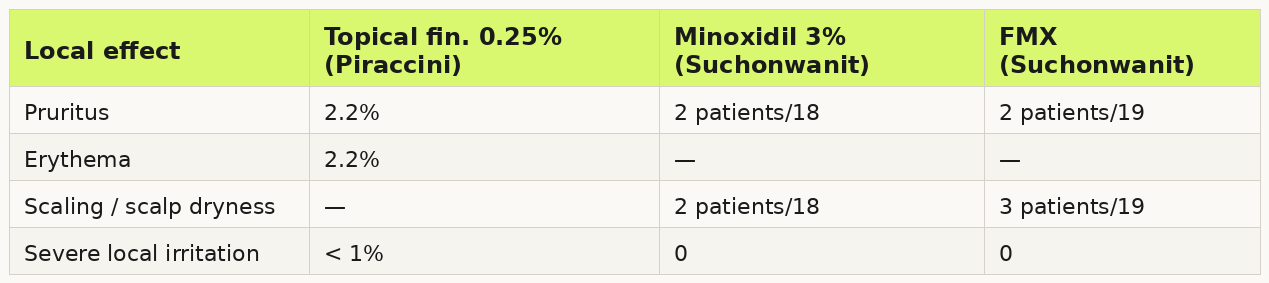
All these local effects were mild in severity, and there was no significant difference between the topical finasteride group and the minoxidil-only group for contact dermatitis or pruritus (Chen et al., 2020; Suchonwanit et al., 2018).
Impact on biological parameters
Biological parameters on topical finasteride 0.25%:
.png)
The wide range of DHT reductions across studies (5.7% vs 34.5%) reflects differences in formulation (solvents, hydroalcoholic base, application time, rinsing or not). Which means there isn't one topical finasteride but a family of formulations with distinct pharmacokinetic profiles.
Am I a good candidate for topical finasteride?
Topical finasteride broadly targets the same profiles as the oral form, with a few notable differences.
Ideal candidate profile
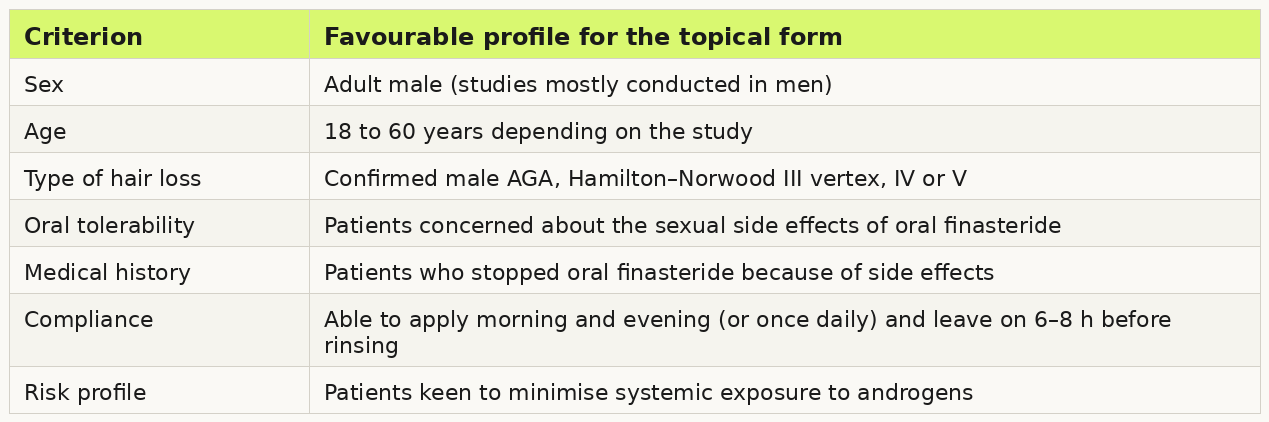
When topical is a particularly good fit compared to oral
Topical finasteride makes especially good sense in these situations:
- Younger men wanting to treat AGA while protecting their fertility (lower systemic DHT impact)
- Patients who had sexual side effects on oral finasteride but still want an anti-DHT treatment
- Patients whose doctor wants to limit systemic DHT reduction for specific clinical reasons
- Patients already on topical minoxidil who want to build on their treatment without switching to an oral drug
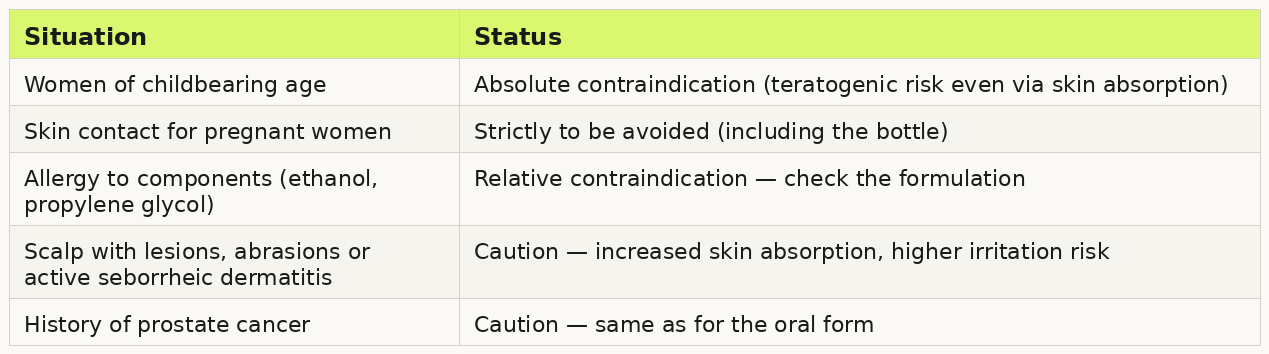
Contraindications and precautions
The question of compliance
Something often underestimated: topical finasteride comes with more of an application burden than the oral tablet. The solution has to be applied to a dry scalp, left on for 6 to 8 hours (or overnight), then rinsed off with water. For some patients, that daily routine is a real barrier to long-term compliance — and a key factor in choosing between the two formulations.
Conclusion
Topical finasteride marks a real step forward in the management of male androgenetic alopecia. Its main strength is preserving hair efficacy statistically equivalent to the oral form while sharply reducing systemic drug exposure.
___
The clinical data available point to several solid conclusions. First, topical finasteride works: as early as 0.005% over 16 months (Mazzarella et al., 1997), and even more so at 0.25% in spray form over 24 weeks, where the hair gain in the target area (20.2 hairs) is numerically identical to that with oral finasteride (21.1 hairs), with statistically significant superiority over placebo (Piraccini et al., 2022). Second, its systemic profile is markedly more favourable: plasma concentrations more than 100 times lower, a shallower serum DHT reduction (34.5% vs 55.6%), no discontinuations for sexual side effects in the phase III trial (Piraccini et al., 2022), and no change in hormone levels at the 0.005% concentration (Mazzarella et al., 1997). Third, combining it with topical minoxidil delivers a meaningful extra benefit: in the Chen et al. (2020) meta-analysis of 5 trials and 640 patients, combined therapy outperforms each monotherapy with an odds ratio of 5.01 for marked improvement versus minoxidil alone, and 2.60 versus finasteride alone.
References
- Mazzarella F et al. (1997). Topical finasteride in the treatment of androgenic alopecia. Preliminary evaluations after a 16-month therapy course. J Dermatol Treat, 8:189–192.
- Piraccini BM et al. (2022). Efficacy and safety of topical finasteride spray solution for male androgenetic alopecia: a phase III, randomized, controlled clinical trial. JEADV, 36:286–294.
- Chen L et al. (2020). The Efficacy and Safety of Finasteride Combined with Topical Minoxidil for Androgenetic Alopecia: A Systematic Review and Meta-analysis. Aesth Plast Surg.
- Suchonwanit P et al. (2018). A randomized, double-blind controlled study of the efficacy and safety of topical solution of 0.25% finasteride admixed with 3% minoxidil versus 3% minoxidil solution in the treatment of male androgenetic alopecia. JEADV, 32:2257–2263.
How does topical finasteride work?
Same mechanism, different route
Topical finasteride shares the same mechanism as the oral form: it inhibits type II 5-alpha-reductase, the enzyme that converts testosterone into dihydrotestosterone (DHT) in the hair follicles. DHT is the androgen directly responsible for the progressive miniaturisation of follicles in genetically predisposed individuals.
The key difference lies in the route of administration. Taken orally, finasteride is absorbed into general circulation and distributed to every tissue that expresses 5-alpha-reductase: hair follicles, prostate, skin, adipose tissue, brain. Applied topically, the drug is deposited straight onto the scalp and penetrates preferentially into the follicles in the upper layers of the dermis, limiting how much reaches the bloodstream.
The pharmacological rationale for the topical form
The topical approach rests on a basic observation: type I 5-alpha-reductase, which finasteride does not target, dominates the skin and sebaceous glands, while type II (finasteride's actual target) is concentrated in the hair follicles themselves. By delivering high concentrations of finasteride straight to the follicles, the topical formulation gets around a theoretical limitation of the oral form, which inhibits type II throughout the body but cannot selectively target the scalp (Mazzarella et al., 1997).
Impact on DHT: scalp vs serum
This is the crux of the distinction between the two formulations. The phase III trial by Piraccini et al. (2022) measured plasma finasteride concentrations and serum DHT levels side by side across the three treatment groups.
Peak plasma concentrations are more than 100 times lower with the topical form than with the oral one. That difference in systemic exposure translates into a shallower serum DHT reduction (34.5% vs 55.6%), yet one that remains statistically significant against placebo (p < 0.05 at every visit). So the topical form does reduce DHT, but in a more localised and less systemic way (Piraccini et al., 2022).
In the Suchonwanit et al. (2018) study, the combined 0.25% finasteride + 3% minoxidil solution produced only a 5.7% reduction in plasma DHT at 24 weeks, with no significant difference from minoxidil alone (p = 0.92). The authors put this very low figure down to the evaluation length (6 months), differences in solvent and formulation base, and variable transdermal absorption across formulations (Suchonwanit et al., 2018).
The variation in systemic DHT impact from study to study shows how much the galenic formulation matters (solvent type, ethanol and propylene glycol content) in determining how much finasteride actually gets absorbed through the skin.