

What is saw palmetto?
Saw palmetto, or Serenoa repens, is a dwarf palm native to North America whose berries have been used in herbal medicine for decades. In hair medicine it is the most studied botanical inhibitor of 5-alpha-reductase to date.
Its active make-up is unusual: the oil pressed from the berries contains 85 to 90% fatty acids (lauric, myristic, oleic and linoleic acid) along with phytosterols, β-sitosterol among them, which together contribute to its anti-androgenic effect (Sudeep et al., 2023).
Unlike finasteride, a synthetic single-target compound, saw palmetto works along two complementary routes:
- A direct action on the cytoplasmic receptors for DHT and androstenediol
- An indirect action through inhibition of 5-alpha-reductase types I and II (Rossi et al., 2012)
.avif)
Le finastéride est-il efficace ?
Téléchargez le dernier guide sur l'efficacité du Finastéride sur les hommes atteints d'alopécie andro-génétique.
What doses have been studied?
The available clinical studies have tested different doses. Here is a summary of the published data:

The 320 mg/day dry extract dose is the one most often found in the scientific literature on hair loss. Sudeep et al. (2023) used an extract standardised to 2–3% β-sitosterol and at least 85% total fatty acids, which underlines how much standardisation matters: products on the market are not equivalent.
⚠️ Worth noting. The quality of the extract, meaning its content of active fatty acids and the extraction method used, directly shapes the results observed. A standardised supercritical CO₂ extract is not comparable to ground berry powder.
Compared with finasteride, does saw palmetto work?
This is the central question in the study by Rossi et al. (2012), run in 100 men with mild to moderate androgenetic alopecia, split into two equal groups over 24 months.
Head-to-head results
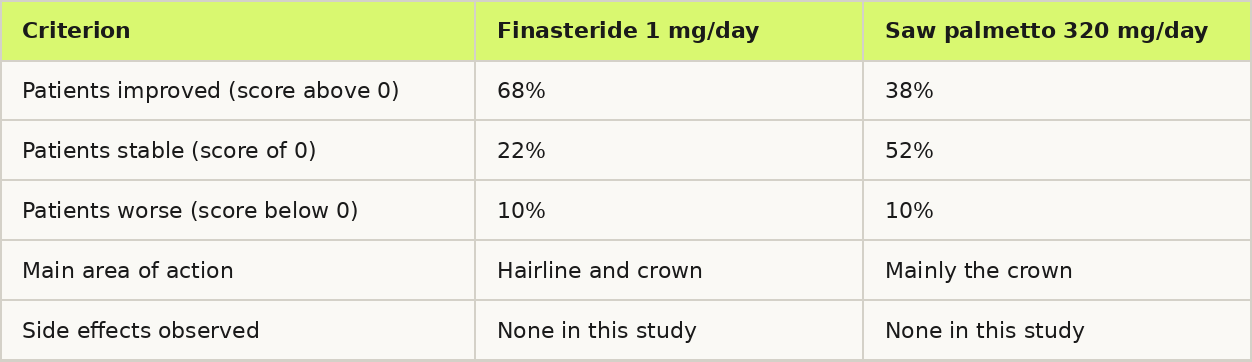
The authors' conclusion is a measured one: finasteride is statistically more effective at driving active regrowth (p < 0.05), but saw palmetto holds the loss steady in more than half of cases (Rossi et al., 2012).
What that means in practice
Saw palmetto is not a match for finasteride in potency. In a patient with stage I to III hair loss on the Hamilton scale, the data do show a real capacity to hold the situation steady. Rossi et al. (2012) put the gap in efficacy down to saw palmetto's lower affinity for 5-alpha-reductase.
Side effects of saw palmetto
A plant origin is no guarantee of harmlessness. That said, in the available studies the tolerability profile of saw palmetto is favourable.
What the studies report
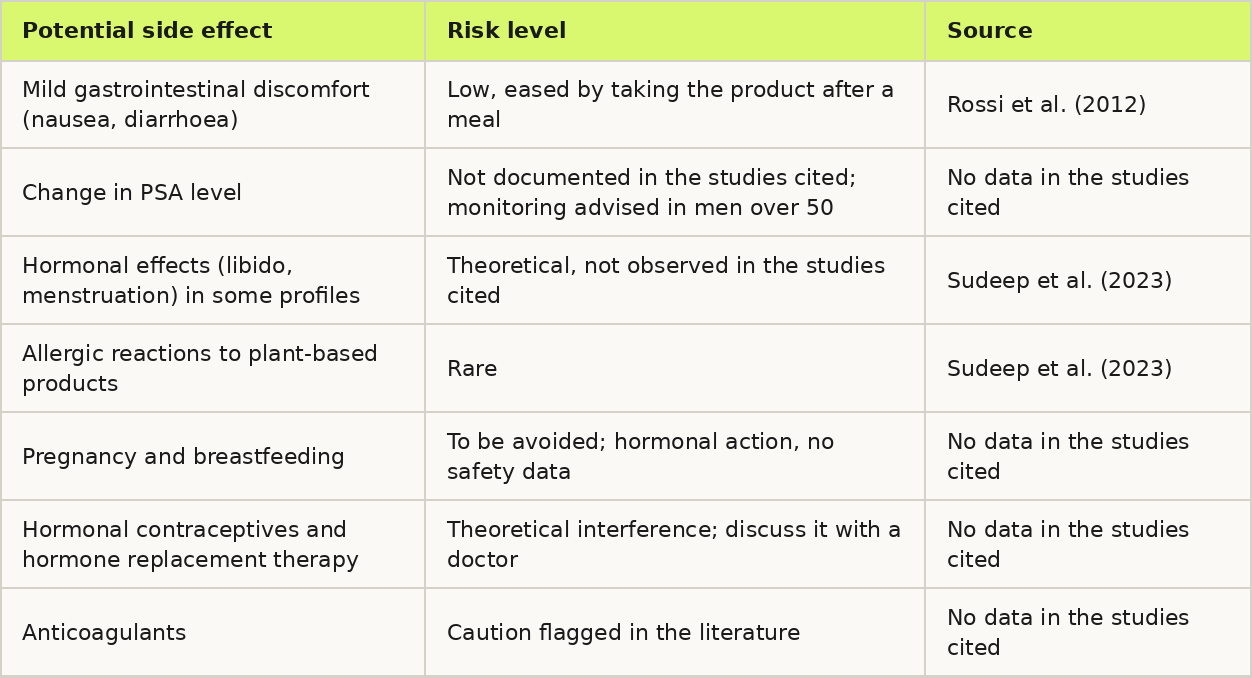
In the study by Rossi et al. (2012), no side effect was observed in either group over 24 months of treatment.
Theoretical risks worth knowing about
In the study by Sudeep et al. (2023), among 73 subjects who completed the 16 weeks, ten participants reported mild adverse effects (common cold, headache). The investigator concluded these events were unrelated to the product tested. No serious adverse effect was reported.
⚠️ Worth noting on prostate screening. Synthetic 5-alpha-reductase inhibitors such as finasteride lower PSA levels substantially and can therefore mask early prostate cancer during standard screening. The studies cited here do not document a comparable effect for saw palmetto, but the data remain limited. Any man over 50, or with a prostate history, should tell his doctor he is taking it before a PSA test.
Which profiles have been studied?
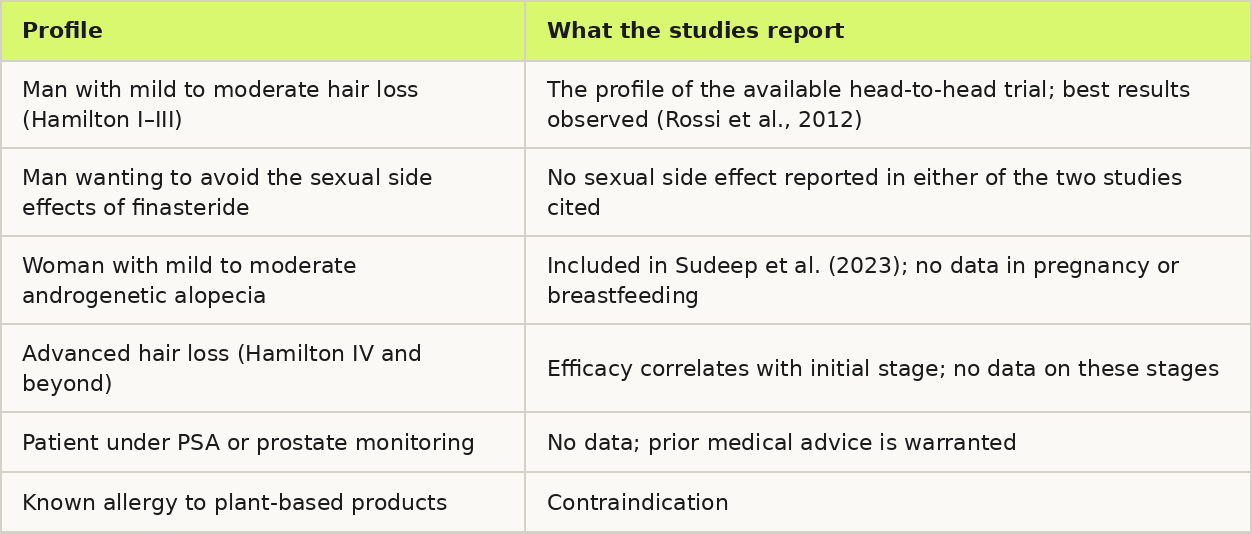
Profiles covered in the literature
Analysis of the Rossi et al. (2012) results shows that efficacy correlates with the initial stage of hair loss (chi² = 8.00; p = 0.004). The best results are seen in patients graded I to III on the Hamilton scale.
What the studies suggest about duration
Sudeep et al. (2023) state themselves that 16 weeks of treatment is not enough to see a significant change in the anagen/telogen ratio. Earlier work used saw palmetto over longer periods to observe effects on active regrowth. The 24-month study by Rossi et al. (2012) confirms that measurable results call for continuous intake over time.
Conclusion
Oral saw palmetto is one of the few plant extracts with controlled clinical data in androgenetic alopecia.
The essentials:
- It inhibits 5-alpha-reductase types I and II and lowers serum DHT measurably (p < 0.001 against placebo; Sudeep et al., 2023)
- Over 24 months it holds the loss steady in 52% of patients and improves it in 38%, against 22% stable and 68% improved on finasteride 1 mg/day (Rossi et al., 2012)
- It is less effective than finasteride at driving active regrowth (p < 0.05), and neither of the two studies cited reports any sexual side effect
- Results correlate with the initial stage of hair loss (chi² = 8.00; p = 0.004) and call for prolonged intake
- Standardisation of the extract, in β-sitosterol and fatty acids, shapes the results observed
For patients looking for something between doing nothing and taking finasteride, oral saw palmetto is the best clinically documented option. Where it fits into an overall strategy is a conversation to have with a doctor.
References
- Rossi A. et al. Comparative Effectiveness of Finasteride vs Serenoa Repens in Male Androgenetic Alopecia: A Two-Year Study. Int J Immunopathol Pharmacol. 2012;25(4):1167–1173.
- Sudeep H.V. et al. Oral and Topical Administration of a Standardized Saw Palmetto Oil Reduces Hair Fall and Improves the Hair Growth in Androgenetic Alopecia Subjects – A 16-Week Randomized, Placebo-Controlled Study. Clin Cosmet Investig Dermatol. 2023;16:3251–3266.



How does saw palmetto work?
The central mechanism: blocking DHT
In androgenetic alopecia, dihydrotestosterone (DHT) binds to receptors in the hair follicles and drives their gradual miniaturisation. The more miniaturised a follicle, the finer and shorter the hair it produces, until it stops being visible.
Saw palmetto interrupts that process by inhibiting 5-alpha-reductase, the enzyme that turns testosterone into DHT. In the study by Sudeep et al. (2023), daily oral intake of a standardised saw palmetto extract (100 mg/day) produced a significant fall in serum DHT compared with placebo (p < 0.001).
Additional mechanisms
Beyond the anti-androgenic effect, several studies cited in Sudeep et al. (2023) suggest saw palmetto also works along other routes:
These complementary effects suggest saw palmetto does more than block DHT: it also acts on the hair growth cycle itself.