

What is topical minoxidil?
The story of topical minoxidil began in the 1970s, entirely by accident. Minoxidil had been developed as a potent oral blood-pressure drug. But among patients treated for severe hypertension, doctors quickly noticed a surprising side effect: abnormal hair growth across the whole body (hypertrichosis). That observation led, as early as 1986, to the development of a topical formulation to harness the hair effect while bypassing the systemic side effects seen at high doses (Gupta et al., Journal of Dermatological Treatment, 2021).
The FDA approved 2% topical minoxidil solution in 1988 for men, then 1992 for women. The 5% solution gained OTC (over-the-counter) approval in 1997 for men, and the 5% foam in 2006 for men, then 2014 for women (Gupta et al., Journal of Dermatological Treatment, 2021).
Today, topical minoxidil remains the only topical medication approved by the French HAS for male and female androgenetic alopecia. Despite the emergence of low-dose oral minoxidil, the topical form keeps a central place in managing hair loss — as a first-line treatment, as part of a combination, or in the context of hair transplant surgery (Gupta et al., Journal of Dermatological Treatment, 2021).
.avif)
Le minoxidil est-il efficace ?
Téléchargez le dernier livre blanc sur l'efficacité du Minoxidil sur les hommes atteints d'alopécie andro-génétique.
What's the recommended dose?
Approved formulations
Topical minoxidil comes in three main forms (Gupta et al., Journal of Dermatological Treatment, 2021):

Solution vs foam: what's the difference?
The solution contains polyethylene glycol (PEG) to improve minoxidil's solubility. PEG is the main culprit behind the scalp irritation, dryness and allergic reactions often wrongly blamed on minoxidil itself. In a patch-test study, 7 of 11 patients were sensitive to PEG, versus only 2 to minoxidil alone (Gupta et al., Journal of Dermatological Treatment, 2021). The foam contains no PEG, so it's better tolerated on sensitive scalps.
Practical dosing recommendations
Men: the recommended formulation is minoxidil 5% (solution or foam). Twice-daily application is what the manufacturer's leaflet recommends, but some experts such as Rogers and Avram advise once-daily application to improve adherence and reduce the risk of contact dermatitis — minoxidil's duration of action justifies this adjustment, since its effect lasts about 72 hours despite a short half-life (Gupta et al., Journal of Dermatological Treatment, 2021).
Women: the approved formulation is the 2% solution twice daily or the 5% foam once daily. Women with a history of hyperandrogenism or hirsutism should start with the 2% to limit the risk of hypertrichosis (Gupta et al., Journal of Dermatological Treatment, 2021).
⚠️ An important point on concentration: raising the concentration beyond 5% doesn't guarantee better efficacy. A randomised study showed that the 10% solution was less effective than the 5% and caused more irritation and shedding, because of the higher amount of PEG in the formulation (Gupta et al., Journal of Dermatological Treatment, 2021).
Is topical minoxidil effective?
The foundational clinical data
The network meta-analysis by Gupta et al. (Journal of Dermatological Treatment, 2021), covering 11 studies and several hundred patients, provides the most complete data available on the comparative efficacy of minoxidil formulations.
Minoxidil 2% vs placebo: the pairwise meta-analysis of 6 studies (740 patients) shows that minoxidil 2% increases terminal hair density by 12.65 hairs/cm² more than placebo after 24 weeks of treatment (95% CI: 7.97–17.34 hairs/cm²), a statistically significant difference. The quality of evidence is rated moderate on the GRADE scale (Gupta et al., Journal of Dermatological Treatment, 2021).
Minoxidil 5% solution vs 2% solution: no statistically significant difference was observed between these two concentrations in the network meta-analysis — though the trend favours the 5% (Gupta et al., Journal of Dermatological Treatment, 2021).
Minoxidil 5% foam vs 5% solution: the two formulations are comparable in efficacy, with no significant difference (Gupta et al., Journal of Dermatological Treatment, 2021).
Efficacy over time
A 5-year study with the 2% and 3% formulations showed a peak in regrowth at 12 months, followed by a gradual decline in the following years. Even so, minoxidil kept non-vellus (terminal) hair density above baseline for the whole study period (Gupta et al., Journal of Dermatological Treatment, 2021). This highlights two important realities:
- The treatment is suspensive: once stopped, shedding usually resumes within the following weeks
- Efficacy peaks at the start of treatment and settles at a level above the no-treatment baseline
Areas of efficacy
A 104-week open-label clinical study showed that 5% minoxidil foam was effective in the frontal, temporal and vertex areas alike — broadening the indication beyond the vertex area alone mentioned in the official leaflet (Gupta et al., Journal of Dermatological Treatment, 2021).
Oral or topical minoxidil?
That's the central question in the randomised, double-blind clinical trial by Penha et al. (JAMA Dermatology, 2024) — the first head-to-head trial comparing oral minoxidil 5 mg/day with topical minoxidil 5% twice a day in 90 men with AGA over 24 weeks.
What the randomised trial shows
On hair-density measures by trichoscopic counting, the oral form tends to improve density slightly more than the topical form, though this difference isn't statistically significant (Penha et al., JAMA Dermatology, 2024).
On blinded photographic assessment by dermatologists:
- Vertex: 70% improvement in the oral group vs 46% in the topical group (p = 0.04) — a statistically significant difference favouring the oral form
- Frontal area: 60% vs 48% — not a significant difference
What the network meta-analysis reveals
In the network meta-analysis by Gupta et al. (Journal of Dermatological Treatment, 2021), oral minoxidil 5 mg/day scores a SUCRA of 100% — the highest of all formulations tested. It proves significantly superior to topical minoxidil 2%, 5% solution and 5% foam. This is, to date, the first analysis to show this potential superiority of the oral form over the topical form in men.
Important nuances
These encouraging data for the oral form should be read with caution:
- The tolerability profile differs. The topical form mainly causes local effects (itching, seborrhoea, PEG-related irritation), whereas the oral form causes more systemic hypertrichosis and headaches. The oral form requires a prescription and follow-up (Penha et al., JAMA Dermatology, 2024).
- The response predictor changes. The topical form's efficacy depends on local follicular sulfotransferase — up to 60% of men are potentially non-responders to the topical form. The oral form partly bypasses this limit by being activated in the liver (Goren & Naccarato, Dermatologic Therapy, 2018).
- The topical form remains the reference first-line treatment — approved, available without a prescription, and backed by several decades of long-term safety data.
The side effects of topical minoxidil
Topical minoxidil has an excellent safety profile, with adverse effects that are essentially local and well tolerated. Systemic absorption is very low: the 2% solution is absorbed at only about 1.4% through intact scalp, and serum concentration usually stays below 5 ng/mL, sometimes undetectable (Gupta et al., Journal of Dermatological Treatment, 2021).
Common side effects
Itching and scalp irritation: this is the most common local side effect. It affects about 8.3% of patients on the 2% solution and 8.8% on the 5% solution (Gupta et al., Journal of Dermatological Treatment, 2021). In most cases the culprit is the PEG — not minoxidil itself. Switching to the 5% foam (PEG-free) often solves the problem.
Hypertrichosis: unlike the oral form, hypertrichosis with the topical form is essentially confined to the scalp and application areas. It mainly affects women:
- 2% solution: 24% of women
- 5% solution: 46.4% of women
In men, topical hypertrichosis is generally minor and well tolerated (Gupta et al., Journal of Dermatological Treatment, 2021).
Initial telogen effluvium (paradoxical shedding): at the start of treatment, a transient shed can occur in the first few weeks. This seemingly paradoxical phenomenon actually reflects resting follicles entering the anagen phase, expelling their telogen hairs to make way for new growing hairs. It's therefore an indirect sign of efficacy. If shedding lasts more than two weeks, a medical consultation is recommended (Gupta et al., Journal of Dermatological Treatment, 2021).
Allergic contact dermatitis: it can be due to minoxidil itself or, more often, to the PEG in the solutions. In that case, the PEG-free foam is recommended as a replacement (Gupta et al., Journal of Dermatological Treatment, 2021).
Summary table of topical minoxidil side effects
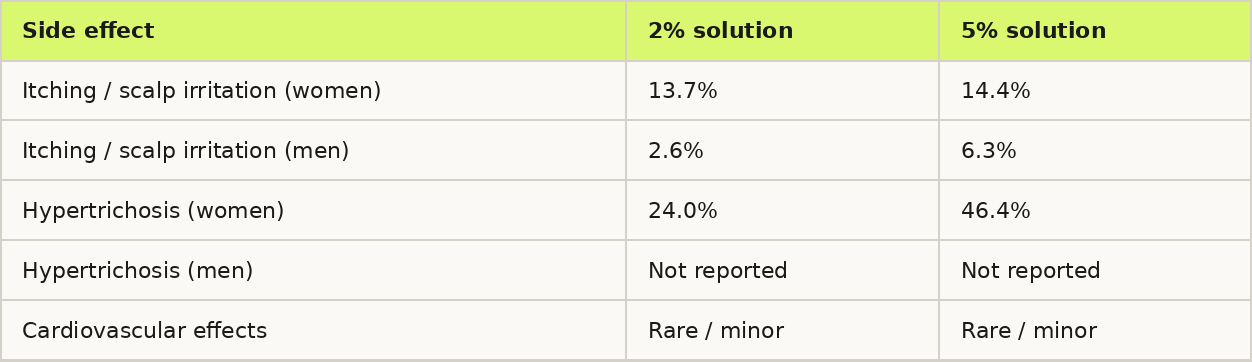
Systemic effects: negligible absorption
Systemic absorption of the topical form is so low that it stays well below the threshold (20 ng/mL) at which haemodynamic changes in blood pressure have been documented. In the comparative trial by Penha et al. (JAMA Dermatology, 2024), no significant change in heart rate or blood pressure was observed in the topical group at 24 weeks.
How do I know if I'm a good candidate for topical minoxidil?
The right indications
Topical minoxidil is approved and recommended for:
Main indications:
- Male androgenetic alopecia (AGA) : official HAS indication
- Female androgenetic alopecia (FPGA) : official HAS indication
- Alopecia areata — well-documented off-label use
- Scarring alopecia, traction alopecia, telogen effluvium — off-label use (Gupta et al., Journal of Dermatological Treatment, 2021)
In the context of hair surgery: topical minoxidil is recommended as an adjuvant treatment before and after hair transplantation. It should be stopped 2 to 3 days before the procedure and resumed within 2 to 14 days afterwards. It helps stabilise shedding, prolong the anagen phase, reduce post-surgical effluvium and support the growth of transplanted grafts (Gupta et al., Journal of Dermatological Treatment, 2021).
The critical point: are you a responder?
This is where topical minoxidil's main limitation lies. About 60% of men with AGA don't respond to the topical treatment (Gupta et al., Journal of Dermatological Treatment, 2021; Goren & Naccarato, Dermatologic Therapy, 2018). This lack of response is explained by insufficient activity of follicular sulfotransferase (SULT1A1) — the enzyme that activates minoxidil in the follicle.
A follicular sulfotransferase assay (FSA) can identify, before treatment, whether a patient is a responder or non-responder to topical minoxidil. It measures sulfotransferase activity in plucked hairs (optical density):
- OD > 0.4: likely responder
- OD < 0.4: likely non-responder
This test has shown 95% sensitivity and 73% specificity for identifying responders (Gupta et al., Journal of Dermatological Treatment, 2021). In a study of 96 patients, it correctly identified 94% of non-responders (Goren & Naccarato, Dermatologic Therapy, 2018).
For identified non-responders: a double-blind study showed that a 15% topical minoxidil solution (a non-standard concentration) enabled 60% of 5% non-responders to achieve a clinically significant response — with no adverse cardiovascular effects, confirming that the vasodilatory effects are also mediated by minoxidil sulfate (Goren & Naccarato, Dermatologic Therapy, 2018).
A little-known interfering factor: aspirin
Daily aspirin (salicylic acid) can inhibit the SULT1A1 enzyme in the liver. Some data suggest it could also reduce this enzyme's activity in the hair follicles, thereby lowering topical minoxidil's efficacy. This point is worth discussing with a doctor for patients on daily antiplatelet treatment (Gupta et al., Journal of Dermatological Treatment, 2021).
Contraindications and precautions
Pregnancy and breastfeeding: Rogers and Avram recommend a conservative approach, advising against topical minoxidil during pregnancy and breastfeeding even though its systemic absorption is very low (Gupta et al., Journal of Dermatological Treatment, 2021).
Women with hyperandrogenism or hirsutism: start with minoxidil 2% rather than 5% to limit the risk of hypertrichosis (Gupta et al., Journal of Dermatological Treatment, 2021).
PEG allergy: opt for the PEG-free 5% foam.
Topical minoxidil in combination: boosting efficacy
For partial responders or those looking to optimise their results, several combinations are documented (Gupta et al., Journal of Dermatological Treatment, 2021):
- Topical minoxidil + topical finasteride: a solution containing 0.25% finasteride and 3% minoxidil showed better results than 3% minoxidil alone in men with AGA.
- Topical minoxidil + topical spironolactone: the combination of 5% minoxidil and 1% spironolactone gel showed a better clinical response than either treatment on its own.
- Topical minoxidil + topical tretinoin: tretinoin combined with minoxidil produces a synergistic effect. It increases follicular sulfotransferase activity: in a cohort study, applying 0.1% tretinoin cream for 5 days converted 43% of non-responders into responders to topical minoxidil.
- Topical minoxidil + microneedling: microneedling creates microchannels through the stratum corneum, improving minoxidil penetration. It also increases sulfotransferase activity and activates the Wnt/β-catenin pathway. The minoxidil + microneedling + PRP combination proved superior to minoxidil alone in a clinical study (Gupta et al., Journal of Dermatological Treatment, 2021).
Conclusion
Topical minoxidil remains the cornerstone of androgenetic alopecia treatment, backed by more than 35 years of HAS (Haute Autorité de Santé) approval and an exceptional level of evidence. Its safety profile is remarkable: negligible systemic effects, moderate and manageable local effects, no risk of adverse sexual effects or neuropsychiatric effects.
Its main advantages are:
- The only topical treatment approved by the HAS for male and female AGA
- Available without a prescription at concentrations up to 5%
- An excellent safety profile with decades of clinical hindsight
- Demonstrated efficacy in the frontal, temporal and vertex areas
- Documented synergies with tretinoin, finasteride, spironolactone and microneedling
Its main limitations are worth knowing: up to 60% of patients may be non-responders because of insufficient sulfotransferase activity, and the effect is suspensive — stopping leads to shedding resuming. The follicular sulfotransferase assay (FSA) can help predict response before starting treatment.
In practice, topical minoxidil remains the logical first step in the medical management of AGA. For non-responders, those who don't tolerate it, or those wanting more convenience, oral minoxidil is a credible and increasingly documented alternative.
References
- Gupta AK, Talukder M, Venkataraman M, Bamimore MA. Minoxidil: a comprehensive review. Journal of Dermatological Treatment. 2021. doi:10.1080/09546634.2021.1945527
- Goren A, Naccarato T. Minoxidil in the treatment of androgenetic alopecia. Dermatologic Therapy. 2018;e12686.
- Penha MA, Miot HA, Kasprzak M, Müller Ramos P. Oral Minoxidil vs Topical Minoxidil for Male Androgenetic Alopecia: A Randomized Clinical Trial. JAMA Dermatology. 2024;160(6):600–605.
- Akiska YM, Mirmirani P, Roseborough I, et al. Low-Dose Oral Minoxidil Initiation for Patients With Hair Loss: An International Modified Delphi Consensus Statement. JAMA Dermatology. 2025;161(1):87–95.




How does topical minoxidil work?
Minoxidil is a prodrug: on its own, it's biologically inactive. Only after conversion into minoxidil sulfate does it become able to act on the hair follicles. This activation is carried out by a key enzyme: follicular sulfotransferase (SULT1A1), located in the outer root sheath of the hair follicle (Goren & Naccarato, Dermatologic Therapy, 2018).
It's precisely this local activation step that fundamentally sets topical minoxidil apart from oral minoxidil. With the topical form, everything depends on how much sulfotransferase is present in the patient's scalp — an important person-to-person variable that explains the wide differences in response seen in the clinic.
Once activated, minoxidil sulfate works through several complementary mechanisms (Gupta et al., Journal of Dermatological Treatment, 2021):
Vasodilation
Minoxidil opens ATP-sensitive potassium channels (K⁺-ATP) in the perifollicular vessels. This mechanism drives membrane hyperpolarisation, reduces intracellular calcium influx and causes local vasodilation. The improved blood supply increases oxygen and nutrient delivery to the hair follicles, boosting their metabolic activity.
Anti-inflammatory effect
Minoxidil reduces perifollicular micro-inflammation, a process involved in the follicular miniaturisation of AGA. It suppresses T-lymphocytes in vitro and inhibits two inflammatory mediators — interleukin-1α (IL-1α) and prostacyclin — in cell-culture models (Gupta et al., Journal of Dermatological Treatment, 2021).
Stimulation of the Wnt/β-catenin pathway
Minoxidil stimulates the release of VEGF (vascular endothelial growth factor) in dermal papilla cells. This VEGF activates the Wnt/β-catenin pathway downstream, a central regulator of follicular regeneration and prolongation of the anagen phase (Gupta et al., Journal of Dermatological Treatment, 2021).
Anti-androgen activity (partial and debated)
In vitro studies have shown that minoxidil reduces expression of the type 2 5α-reductase gene in human keratinocytes. This property is disputed, however, by other studies that found no significant anti-androgen effect in dermal papilla cells or in animal models. This avenue remains to be confirmed (Gupta et al., Journal of Dermatological Treatment, 2021).
DNA synthesis and the hair cycle
Minoxidil increases DNA synthesis in the hair bulb during the anagen phase and activates secondary germ cells in telogen-phase follicles, triggering the start of the anagen phase earlier. In practice, minoxidil shortens the telogen phase (rest) and prolongs the anagen phase (growth), gradually increasing follicle diameter and length (Gupta et al., Journal of Dermatological Treatment, 2021).