
.webp)
What is topical dutasteride?
Topical dutasteride is a galenic formulation of dutasteride intended for direct application to the scalp. Unlike the oral route, which distributes the molecule throughout the body, the topical route aims to concentrate the effect at follicular level — where the problem actually sits in androgenetic alopecia (AGA).
This approach isn't entirely new: dutasteride mesotherapy (intradermal injections) has been around for several years (Ding et al., 2024). But developing topical solutions you apply yourself — without injection — is an important step towards a more accessible and better-tolerated treatment.
To date, no topical dutasteride formulation has received marketing authorisation (not in Europe, not in the United States, and not in the countries where oral dutasteride is approved for AGA, such as South Korea and Japan). Phase II clinical trials have nonetheless produced very encouraging data (Panuganti et al., 2025). Compounding pharmacies also offer magistral formulations, but without standardisation or independent clinical evaluation.
A note on the galenic challenge: dutasteride is an extremely lipophilic molecule (log P = 5.09) and practically insoluble in water (0.038 ng/mL). This makes it very hard to formulate a topical product that is effective, stable and non-greasy. Conventional oil-based solutions struggle to penetrate the deeper skin layers and leave an unpleasant greasy feel (Andrade et al., 2025). That's why research is turning towards nanocarriers able to target the hair follicle specifically.
.avif)
Le finastéride est-il efficace ?
Téléchargez le dernier guide sur l'efficacité du Finastéride sur les hommes atteints d'alopécie andro-génétique.
What's the recommended dose?
This is where the situation differs from the oral route: there is as yet no standardised dose or official recommendation for topical dutasteride in AGA. The available data come mainly from the phase II study by Panuganti et al. (2025), which tested three different concentrations.
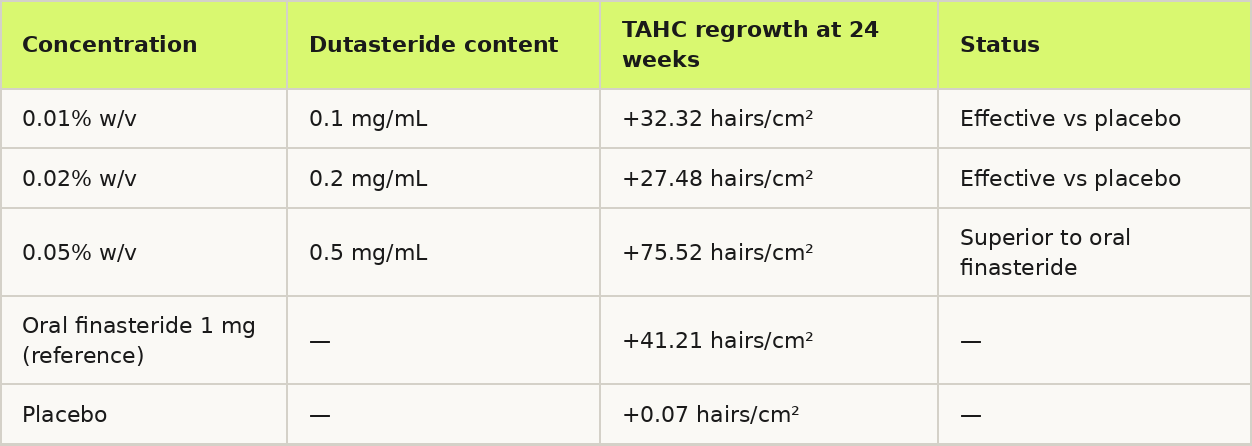
The 0.05% w/v concentration (i.e. 0.5 mg of dutasteride per mL of solution) stands clearly apart from the other two. It's the only one to have shown statistically significant superiority over oral finasteride 1 mg (p = 0.0083), and the only one to have significantly improved TAHC as early as week 12 (p = 0.038 vs placebo).
In the study, 1 mL of solution was applied daily with a dropper to a targeted circular area of about 1.9 cm² at the vertex, left in place for at least 6 to 8 hours (Panuganti et al., 2025). In clinical practice, magistral formulations generally cover a wider area depending on the extent of the alopecia.
For the microneedling + topical dutasteride 0.01% combination, the study by Sánchez-Meza et al. (2022) used 3 sessions 4 weeks apart with 1 mL of 0.01% solution applied after the session, at a penetration depth of 2.5 mm.
⚠️ With no marketing authorisation and no standardised protocol, any use of topical dutasteride must be supervised by a doctor. The magistral formulations available in pharmacies or online vary considerably in concentration, excipients and bioavailability.
Is topical dutasteride effective?
The clinical data available are still limited compared with the oral route, but the results of the existing studies are promising.
Pivotal study: Panuganti et al., 2025 (phase II, n = 135, 24 weeks)
This is the most rigorous study available to date on topical dutasteride: randomised, double-blind, controlled against both placebo and active oral finasteride, multicentre. The main results for the 0.05% concentration:
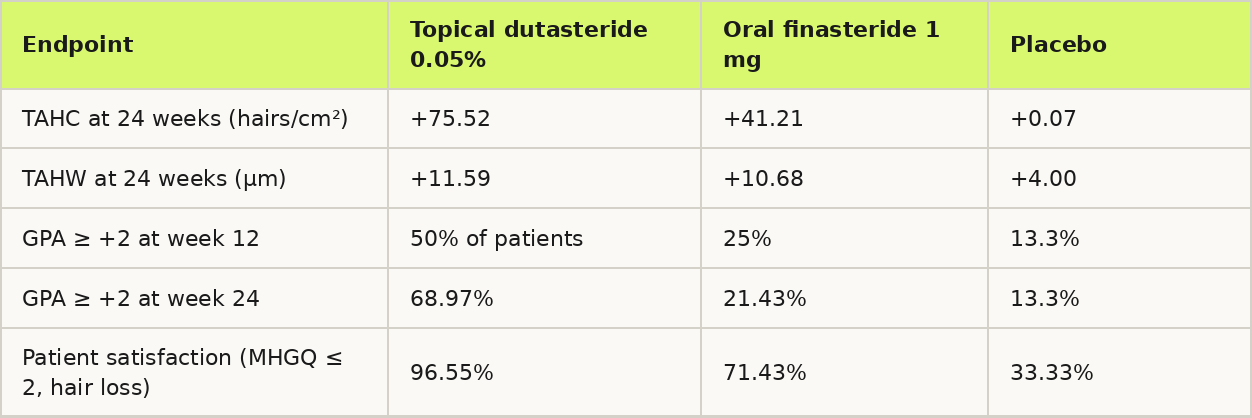
One particularly notable result: while topical dutasteride 0.05% outperforms oral finasteride on hair density (+75.52 vs +41.21 hairs/cm²), efficacy on shaft thickness (TAHW) is similar between the two formulations (+11.59 µm vs +10.68 µm), with no statistically significant difference between them (Panuganti et al., 2025).
Microneedling + topical study: Sánchez-Meza et al., 2022 (n = 34, 16 weeks)
This small but rigorous Mexican study (randomised, double-blind, controlled against saline) assessed microneedling combined with a 0.01% topical dutasteride solution. At 16 weeks:
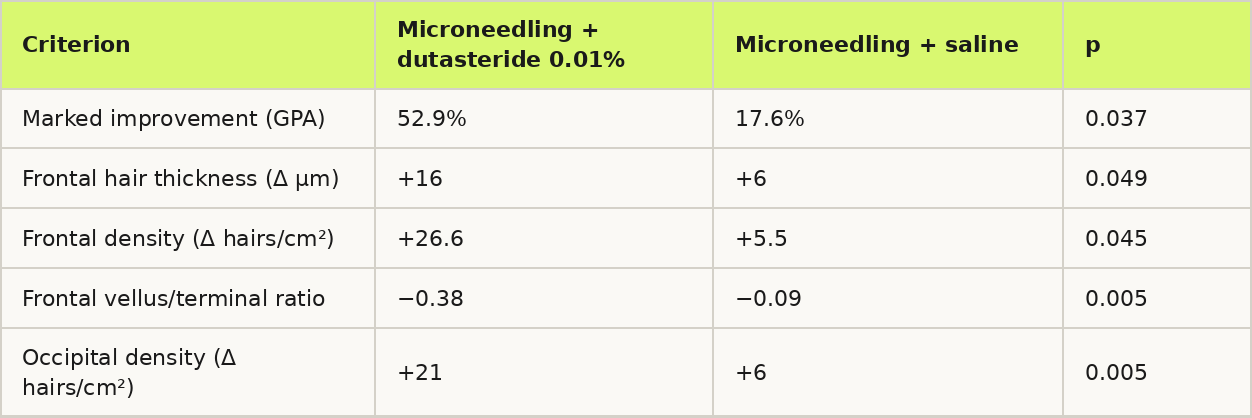
One notable point: 88.8% of the patients who achieved marked improvement in the dutasteride group had a Hamilton-Norwood grade between II and IV, suggesting a better response in moderate rather than severe stages (Sánchez-Meza et al., 2022).
Comparison with topical finasteride data
The authors of the Panuganti et al. (2025) study point out that topical dutasteride at all the concentrations tested (0.01%, 0.02% and 0.05%) produced a greater change in TAHC at 24 weeks than the published data for topical finasteride spray (+32.32%, +27.48% and +75.52% respectively, versus +20.20% for topical finasteride).
Oral or topical dutasteride?
As with oral dutasteride, no study directly compares topical and oral dutasteride. The available data come from separate studies with different populations, measurement methods and durations, which makes any direct comparison risky.
What the data do allow us to observe:
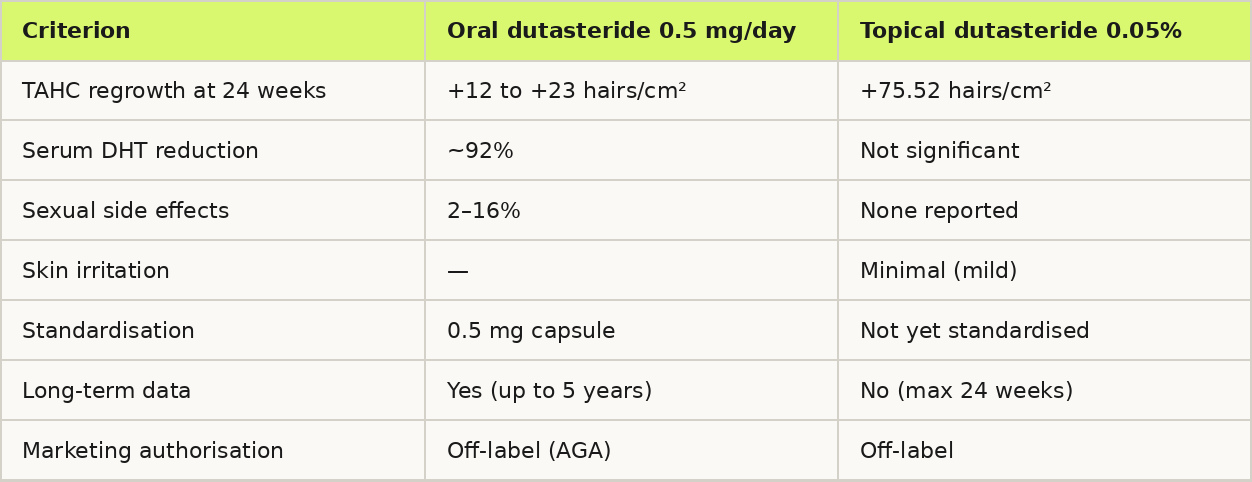
A caution on interpreting the regrowth figures: the TAHC values look far higher for the topical form. But the studies aren't directly comparable — populations, target-area measurements, the trichoscopy used and the context all differ. So it's worth staying cautious before concluding that the topical form is "5 times more effective" than the oral one.
What can be stated with confidence:
- Topical dutasteride is effective on hair regrowth and outperforms oral finasteride in the Panuganti et al. (2025) study
- It doesn't induce significant systemic hormonal change, which is a real advantage for patients concerned about systemic effects
- The oral route benefits from more robust long-term data (studies up to 5 years) and better galenic standardisation
- The topical form remains an experimental formulation requiring phase III trials to confirm these results at scale (Panuganti et al., 2025)
The side effects of topical dutasteride
This is one of the topical route's main potential strengths: a tolerability profile markedly more favourable than the oral route, thanks to low systemic absorption.
In the Panuganti et al. (2025) study, no serious adverse events were reported across the whole 28-week study period. Specifically:
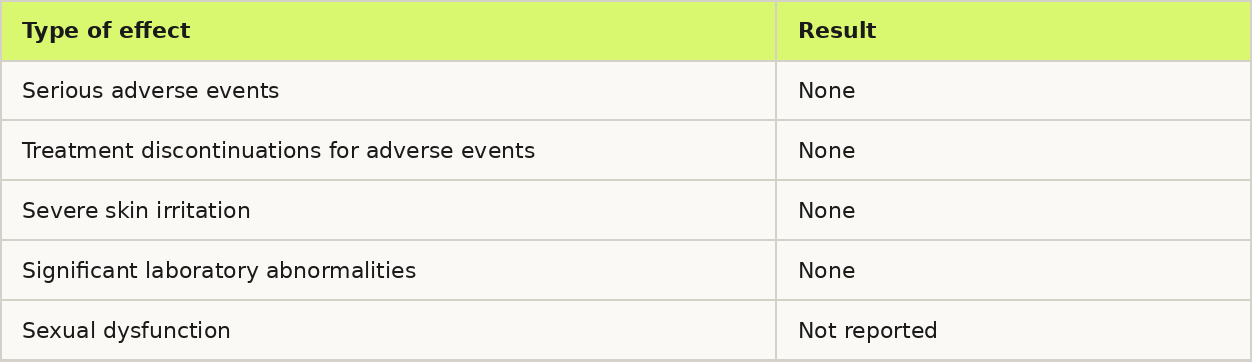
The only local effects observed were cosmetic and benign: slightly shiny appearance, markedly shiny appearance, and shine with scaling and cracking, present in all groups including placebo (Panuganti et al., 2025). Since the solution contains 30% dehydrated alcohol, these observations of mild scaling are expected.
For the microneedling + topical dutasteride combination, the adverse effects observed were linked to the microneedling technique itself: erythema and scalp tenderness for less than 36 hours in 84.2% of treated patients (and 88.2% in the saline control group), with no significant difference between groups (Sánchez-Meza et al., 2022). Pain during the procedure was moderate in both groups.
On systemic effects
Although the plasma dutasteride concentrations measured after topical application are almost undetectable, a few nuances deserve attention according to the review by Andrade et al. (2025):
- Dutasteride's half-life is dose-dependent: at low concentrations (such as those obtained topically), elimination kinetics are non-linear and the half-life may be well below the 5 weeks observed with the oral route, which minimises the risk of accumulation
- The scalp is richly vascularised: residual systemic absorption can't be entirely ruled out, particularly with repeated applications over large areas (Andrade et al., 2025)
- Phase III studies with full hormonal monitoring are still needed to confirm long-term safety
How do I know if I'm a good candidate for topical dutasteride?
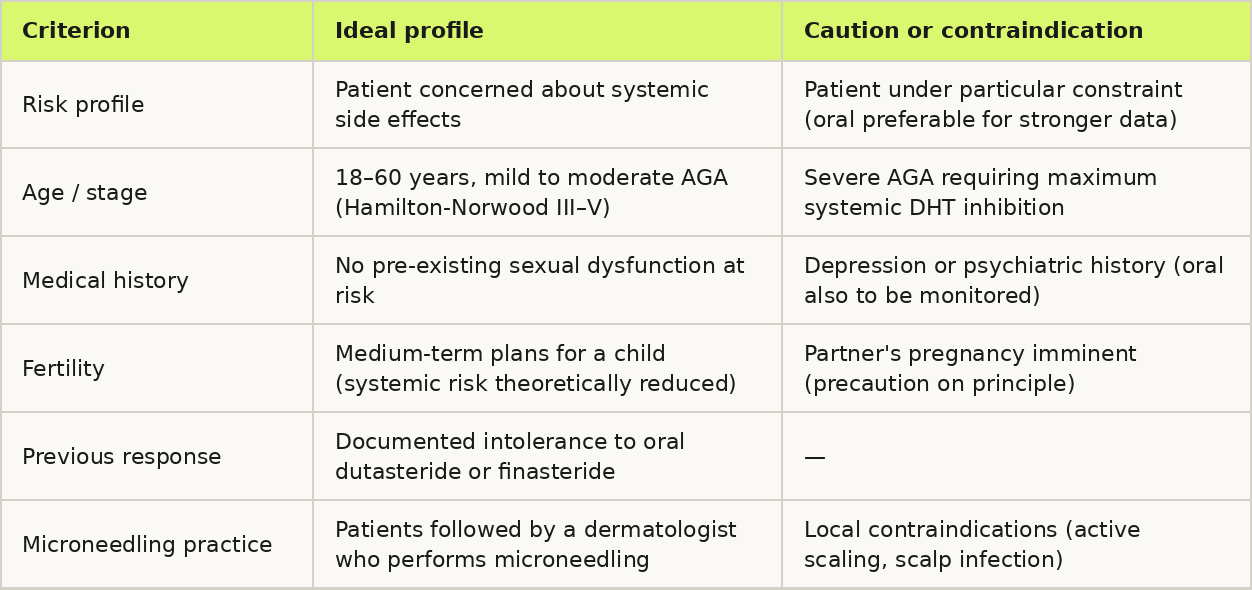
Topical dutasteride is particularly indicated if:
- You have stopped oral dutasteride or finasteride because of sexual or neuropsychological side effects
- You want to start anti-DHT treatment but prefer to avoid systemic risks while waiting for long-term data on the topical route
- You have medical follow-up allowing regular microneedling sessions, which appear to amplify the topical form's efficacy (Sánchez-Meza et al., 2022)
What still argues for the oral route:
- Far more robust long-term efficacy and safety data (up to 5 years)
- Galenic standardisation (0.5 mg capsule) guaranteeing a precise, reproducible dose
- More complete systemic DHT inhibition for severe or progressive AGA
Nanocarriers: the future of topical dutasteride?
This is an active and promising field of research. The challenge is to develop systems able to deliver dutasteride specifically into the hair follicle, where the 5-alpha-reductases act, without the molecule diffusing into the deeper dermal layers and the blood microcirculation.
Several types of nanocarrier have been studied (Andrade et al., 2025):
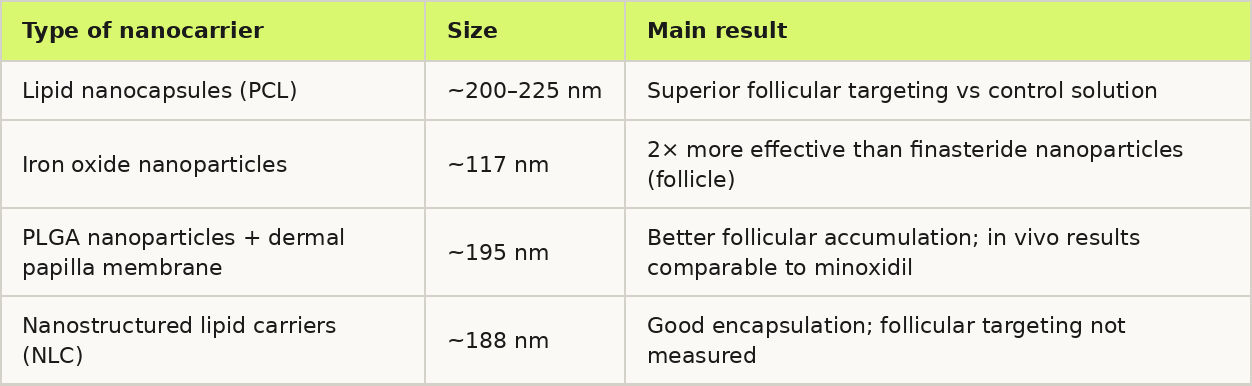
Nanoparticle size is a key factor: particles of 50 to 230 nm tend to target the sebaceous gland and the upper part of the follicle, whereas sizes around 600 nm would be ideal for reaching the follicular bulb — the dermal papilla area where 5-alpha-reductase resides and where the therapeutic action is needed (Andrade et al., 2025).
Another underestimated factor is the influence of scalp sebum on nanocarrier penetration: recent studies show that sebum content can significantly alter the follicular deposition of nanosystems (Andrade et al., 2025).
In short, nanocarriers are a very interesting therapeutic avenue that could maximise topical dutasteride's local efficacy while minimising its systemic exposure — but we are still at the preclinical or early clinical stage for most of these formulations.
Conclusion
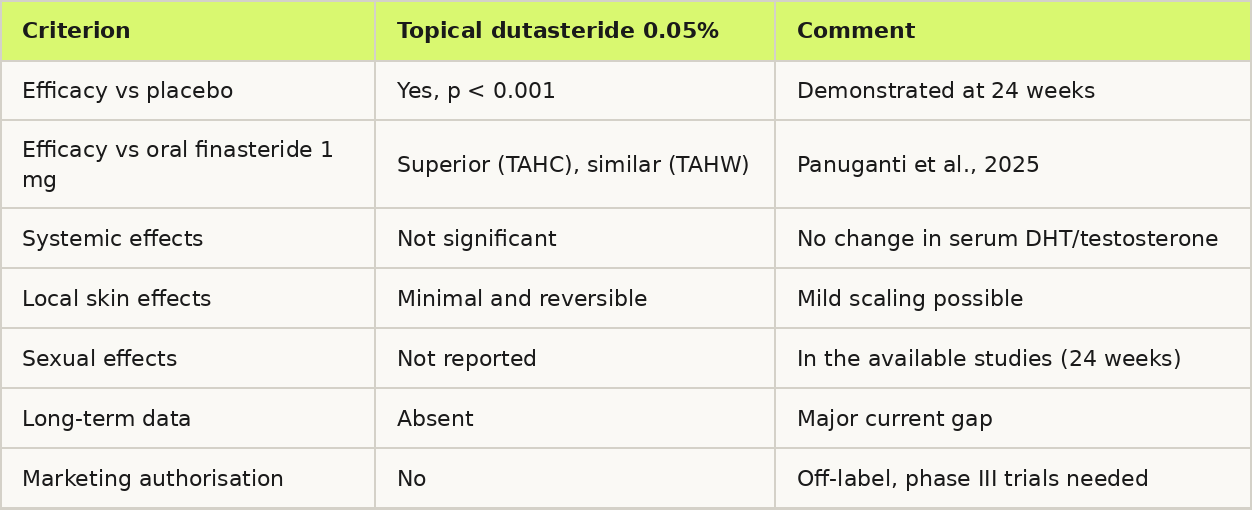
Topical dutasteride represents a promising but still emerging therapeutic route in the treatment of androgenetic alopecia. Its main advantage is delivering the anti-DHT action locally, at follicle level, with almost no systemic absorption — which makes it a credible alternative for patients concerned about the side effects of the oral route.
The current data can be summarised as follows:
The microneedling + topical dutasteride combination also offers an interesting avenue by allowing better follicular penetration through the microchannels created by the needles, with significant results from as early as 16 weeks even at a concentration of 0.01% (Sánchez-Meza et al., 2022).
The future probably belongs to nanocarriers targeting the hair follicle specifically, able to maximise local concentration while maintaining zero systemic exposure (Andrade et al., 2025). Large-scale phase III clinical trials are needed to confirm the efficacy and safety of these approaches over the long term.
References
- Panuganti VK, et al. A Randomized, Double-Blind, Placebo and Active Controlled Phase II Study to Evaluate the Safety and Efficacy of Novel Dutasteride Topical Solution (0.01%, 0.02%, and 0.05% w/v) in Male Subjects With Androgenetic Alopecia. Cureus. 2025;17(8):e89309.
- Sánchez-Meza E, et al. Microneedling plus topical dutasteride solution for androgenetic alopecia: a randomized placebo-controlled study. J Eur Acad Dermatol Venereol. 2022;36(10):e806–e808.
- Andrade JFM, et al. Topical dutasteride for androgenic alopecia: current state and prospects. Therapeutic Delivery. 2025;16(3):271–283.
- Ding Y, Wang C, et al. Dutasteride for the Treatment of Androgenetic Alopecia: An Updated Review. Dermatology. 2024;240:833–843.



How does topical dutasteride work?
The molecular mechanism of action is identical to the oral route: dutasteride inhibits the type I and II isoenzymes of 5-alpha-reductase, blocking the conversion of testosterone into DHT within the hair follicle itself. What changes is the route of administration, and therefore the pharmacokinetic profile.
The pharmacokinetic study by Panuganti et al. (2025) on the 0.05% topical solution provides concrete data: after application, the plasma concentrations measured were almost all below or close to the lower limit of quantification (LLOQ = 50.125 pg/mL). By comparison, oral dutasteride 0.5 mg reaches a peak plasma concentration of around 1,270 pg/mL. Systemic exposure with the topical form is therefore tens of times lower than with the oral route.
In practice, this translated into no significant change in serum testosterone or DHT levels in the topical dutasteride groups, whereas the oral finasteride 1 mg group showed a 20% rise in testosterone and a roughly 11% reduction in DHT at week 24 (Panuganti et al., 2025). The topical form's local action therefore appears genuine, with no measurable systemic hormonal interference.