
.webp)
What is oral dutasteride?
Dutasteride is a molecule originally developed to treat benign prostatic hyperplasia (BPH), approved by the US FDA at a dose of 0.5 mg/day for that indication. Outside the United States, South Korea and Japan have officially approved its use in male androgenetic alopecia. In Europe and France, its use in AGA remains off-label, though it is widely practised and documented in the scientific literature.
What sets it apart from finasteride (the other available 5-ARI) is that it inhibits both the type I and type II isoenzymes of 5-alpha-reductase, two enzymes both present in the hair follicle. This dual inhibition gives it theoretically — and clinically — greater potency against AGA.
.avif)
Le finastéride est-il efficace ?
Téléchargez le dernier guide sur l'efficacité du Finastéride sur les hommes atteints d'alopécie andro-génétique.
What's the recommended dose?
The standard dose validated by clinical studies and approved in Japan and South Korea for AGA is 0.5 mg per day, taken orally as a single dose.
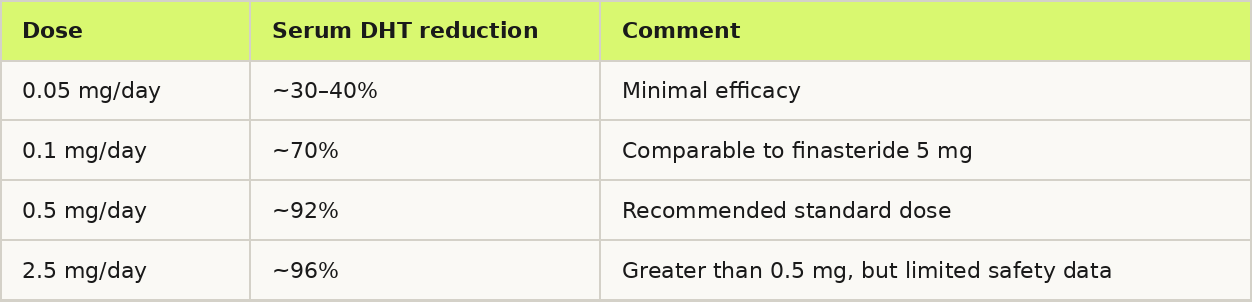
Source: Olsen et al., 2006
The study by Olsen et al. (2006) demonstrates a clear dose-response relationship: the higher the dose, the stronger the DHT suppression and the greater the regrowth. That said, only the 0.5 mg/day dose is approved for BPH and is the one used in the vast majority of clinical studies on AGA.
A daily dose at a fixed time is recommended. Because of dutasteride's long half-life, intermittent regimens (2–3 times a week) have been explored with efficacy preserved in retrospective studies (Ding et al., 2024), but daily dosing remains the standard.
⚠️ In France, dutasteride for AGA has no marketing authorisation: it is prescribed off-label, which necessarily involves a medical prescription and regular follow-up.
Is oral dutasteride effective?
This is where the data are most convincing. Here is a summary of the main randomised controlled trials, all run over 24 weeks:
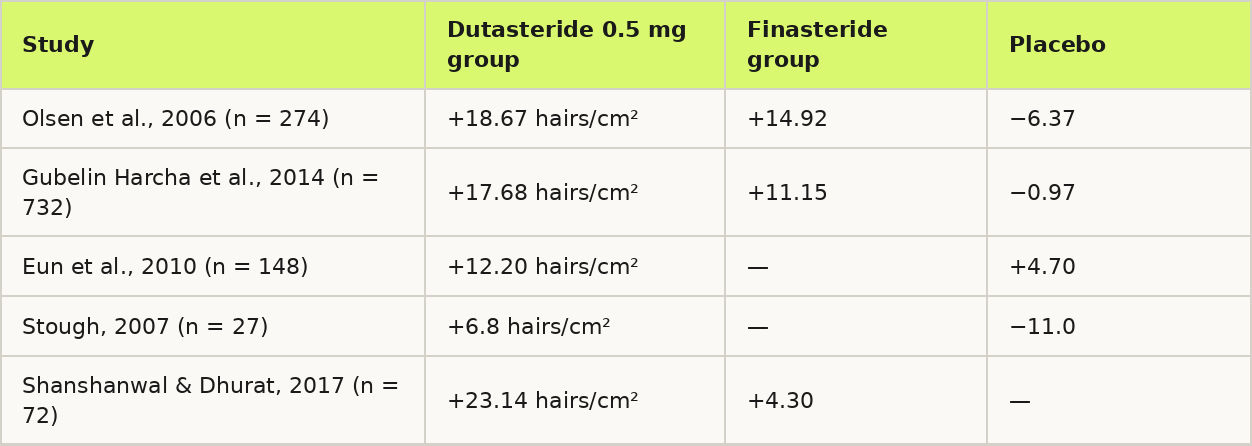
Source: Ding et al., 2024 (synthesis) — results standardised as hairs/cm²
In the study by Shanshanwal & Dhurat (2017), which directly compares dutasteride 0.5 mg with finasteride 1 mg (the dose actually used in practice, not 5 mg), the results are particularly striking:
- Total hair count: +23.14/cm² (dutasteride) vs +4.30/cm² (finasteride), p < 0.001
- Thick hairs (terminal regrowth): +30.51/cm² vs +5.57/cm², p < 0.001
- Reversal of miniaturisation (fewer fine hairs): −7.37/cm² vs −1.27/cm², p = 0.015
- Blinded photographic assessment: 74.2% of dutasteride patients rated moderately or greatly improved vs 32.4% for finasteride, p < 0.001
Put simply: in this study, dutasteride produced roughly 5 times more regrowth than finasteride at 24 weeks.
Longer-term retrospective studies confirm that efficacy is maintained over time. A study of 99 patients treated for more than 5 years concludes that dutasteride 0.5 mg is a safe, effective treatment delivering good long-term results (Choi et al., 2024, cited in Ding et al., 2024).
Oral or topical dutasteride?
Many patients ask this, and the honest answer is: no study directly compares topical and oral dutasteride. It is therefore impossible to settle the question with certainty at this stage.
What we do know is that both formulations have shown efficacy individually. A recent phase II study (Panuganti et al., 2025), however, compared a 0.05% topical dutasteride solution with oral finasteride 1 mg — which allows an interesting indirect comparison.
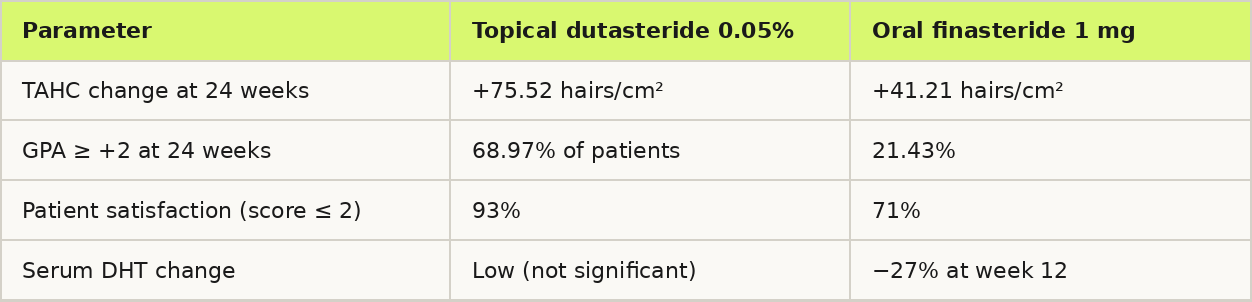
What stands out: topical dutasteride 0.05% beat oral finasteride at 24 weeks (p = 0.0083), without significantly altering serum hormone levels, which suggests local action with less systemic exposure — and therefore potentially fewer side effects.
What this tells us:
- The topical route looks promising for reducing systemic effects
- The 0.05% topical formulation is more effective than oral finasteride 1 mg
- But comparing topical and oral dutasteride directly remains impossible with current data — dedicated clinical trials are needed
The side effects of oral dutasteride
This is often patients' main concern. Dutasteride's adverse effects are mainly sexual in nature, and their incidence varies between studies.
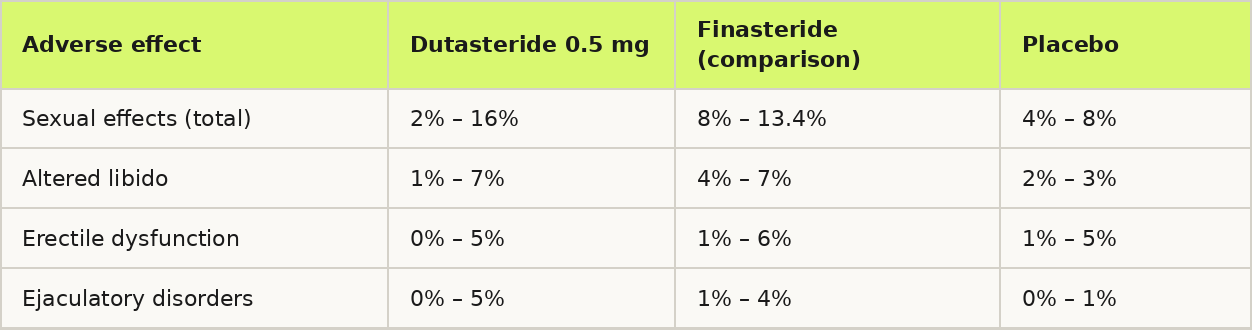
Key points to remember:
Most sexual effects are transient. In a prospective 52-week study (120 patients), sexual effects (15.8% overall) were concentrated in the first 6 months and declined thereafter. Of the 19 patients affected, 6 saw their symptoms resolve during treatment and 13 after stopping (Tsunemi et al., 2016, cited in Ding et al., 2024).
Incidence falls over time. In a 4-year phase III trial for BPH (0.5 mg/day): reduced libido affected 3.7% in year 1, 0.6% in year 2, 0.4% in year 3 and 0.1% in year 4 (Debruyne et al., 2004, cited in Ding et al., 2024).
Depression risk to monitor. 5-alpha-reductase plays a role in neurosteroid synthesis. Several meta-analyses report a slightly raised risk of depression on a 5-ARI (finasteride or dutasteride). This risk should be taken into account, particularly in patients with a history of depression (Ding et al., 2024).
Effect on sperm parameters. A randomised trial (99 healthy men, 1 year) showed a reduction in total sperm count and seminal volume on dutasteride, but these changes were reversible after stopping treatment (Amory et al., 2007, cited in Ding et al., 2024).
Long half-life: specific precautions
- Do not donate blood during treatment or for at least 6 months after stopping
- To be avoided in women who are pregnant or may become pregnant (risk of feminisation of a male foetus)
- DHT levels can take several months to return to normal after stopping: a median of 86 days for 0.5 mg, 155 days for 2.5 mg (Olsen et al., 2006)
How do I know if I'm a good candidate for oral dutasteride?
Here is a summary of eligibility criteria based on the populations studied in the clinical trials:
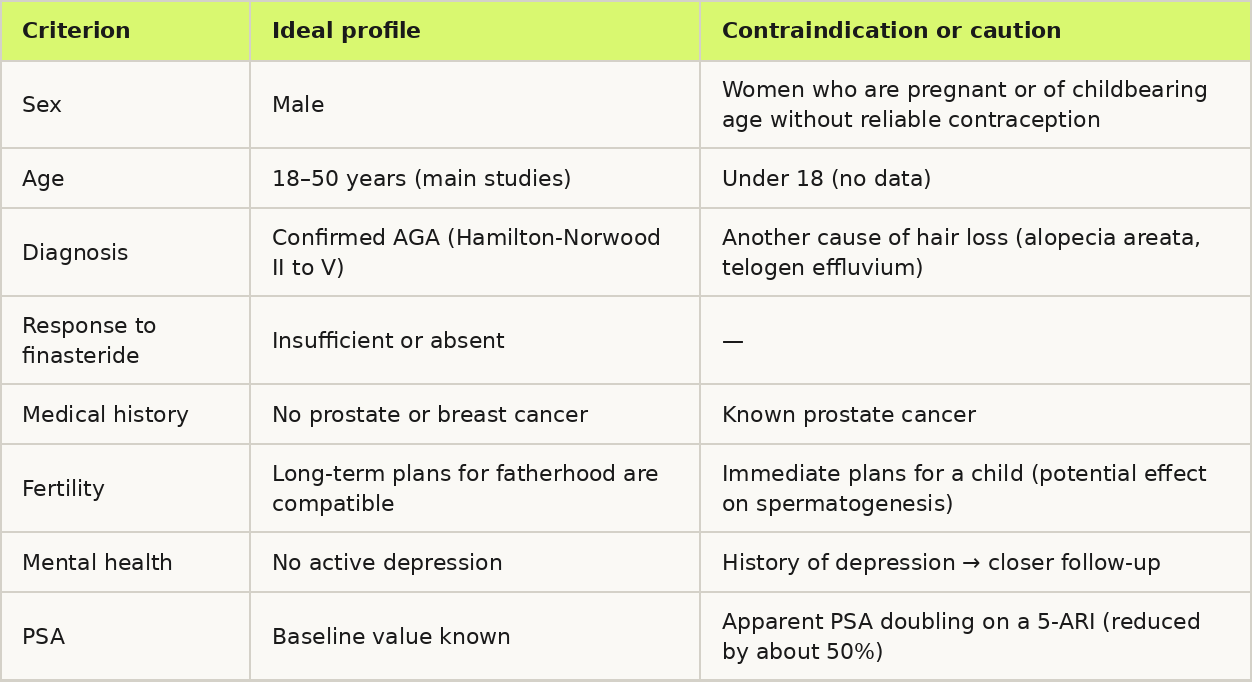
Oral dutasteride is particularly indicated if:
- You have tried finasteride for at least 6–12 months with an insufficient response. A study by Jung et al. (2014, cited in Shanshanwal & Dhurat, 2017) showed that among 31 men who did not respond to finasteride, switching to dutasteride 0.5 mg increased hair density by 10.3% and shaft thickness by 18.9% in 6 months.
- You have severe AGA (grades IV–V) requiring maximum DHT inhibition.
- You want to combine several approaches: a recent study (Jha et al., 2025) shows that adding oral minoxidil 2.5 mg to oral dutasteride produces markedly greater regrowth (+49.7 hairs/cm² in combination vs +30.4 on dutasteride monotherapy, p < 0.001), with a good safety profile.
In practice: only a dermatologist or a doctor specialising in trichology can confirm the indication, prescribe the treatment off-label and provide the necessary follow-up (hormone panel, PSA if over 40, monitoring of liver function).
Conclusion
Oral dutasteride at 0.5 mg/day is currently the most effective drug treatment available for male androgenetic alopecia, superior to finasteride in every direct comparative study. That superiority is explained by its dual inhibition of the type I and II isoenzymes of 5-alpha-reductase, cutting serum DHT by around 92% — well beyond the 70–73% achieved with finasteride 5 mg.
What the studies tell us, in summary:
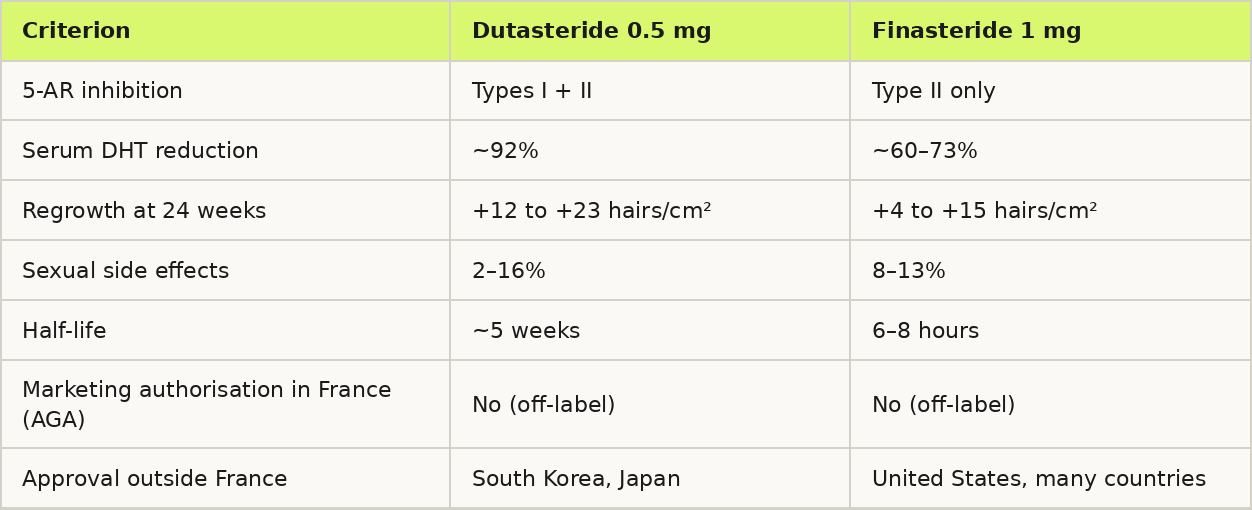
Its off-label use in France strictly requires a medical prescription and regular follow-up. The side effects, while real, are in the vast majority of cases mild, moderate and reversible once treatment stops, with an incidence that tends to fall the longer treatment continues.
For patients looking to maximise their result, emerging data suggest that combining oral dutasteride with low-dose oral minoxidil could be the most effective protocol currently available short of a hair transplant (Jha et al., 2025).
ReferenceS
- Shanshanwal SJ, Dhurat RS. Superiority of dutasteride over finasteride in hair regrowth and reversal of miniaturization in men with androgenetic alopecia. Indian J Dermatol Venereol Leprol. 2017;83:47-54.
- Ding Y, Wang C, et al. Dutasteride for the Treatment of Androgenetic Alopecia: An Updated Review. Dermatology. 2024;240:833–843.
- Olsen EA, Hordinsky M, et al. The importance of dual 5α-reductase inhibition in the treatment of male pattern hair loss. J Am Acad Dermatol. 2006;55:1014-23.
- Jha AK, Deb S, et al. Comparison between oral low dose dutasteride versus oral low dose dutasteride along with oral low dose minoxidil in treatment of androgenetic alopecia in males. Int J Acad Med Pharm. 2025;7(3):190-193.
- Panuganti VK, et al. A Randomized, Double-Blind, Placebo and Active Controlled Phase II Study to Evaluate the Safety and Efficacy of Novel Dutasteride Topical Solution in Male Subjects With Androgenetic Alopecia. Cureus. 2025;17(8):e89309.



How does oral dutasteride work?
Circulating testosterone is converted into DHT (dihydrotestosterone) by an enzyme called 5-alpha-reductase, which exists in three isoforms (types I, II and III). Types I and II are both present in the scalp and the hair follicles.
DHT binds to the follicle's androgen receptors, progressively shortening the anagen (growth) phase and miniaturising the hair shafts: that is androgenetic alopecia.
Dutasteride blocks both type I and type II 5-alpha-reductase:
The result: at the standard dose of 0.5 mg/day, dutasteride reduces serum DHT levels by around 92%, compared with about 70–73% for finasteride 5 mg (Olsen et al., 2006). In the scalp specifically, the reduction is about 51% for dutasteride 0.5 mg versus about 41% for finasteride 5 mg (Olsen et al., 2006).
Its long half-life (~5 weeks) matters: dutasteride remains detectable in serum for 4 to 6 weeks after stopping treatment, which entails particular precautions (blood donation in particular) (Ding et al., 2024).
In addition, 5-alpha-reductase inhibitors lower PSA (prostate-specific antigen), which needs to be taken into account if prostate cancer screening is planned: PSA values under a 5-ARI must be interpreted with that effect in mind.